This week's Trumpist is actually President Donald Trump. If he weren't President it would be hard to be critical of him for what he said even though it is easy to criticize what he said. He is just a typical American completely unfamiliar with the facts of American history while repeating the mythology of that history:
TRUMP: [President Andrew Jackson] was a swashbuckler. But when his wife died, did you know he visited her grave everyday? I visited her grave actually because I was in Tennessee.
ZITO: That's right. You were in Tennessee.
TRUMP: And it was amazing. The people of Tennessee are amazing people. They love Andrew Jackson. They love Andrew Jackson in Tennessee.
ZITO: He's fascinating.
TRUMP: I mean, had Andrew Jackson been a little later, you wouldn't have had the Civil War. He was a very tough person, but he had a big heart. He was really angry that he saw what was happening with regard to the Civil War. He said, “There's no reason for this.” People don't realize, you know, the Civil War — if you think about it, why? People don't ask that question, but why was there a Civil War? Why could that one not have been worked out?
First of all, Andrew Jackson may be loved by some in Tennessee, but in fact historically he was the Englishic-American who most successfully advocated for the inclusion of the genocide of Native Americans in U.S. policy.
Second, Andrew Jackson died in 1845, 16 years before the Civil War started. It is fair to assume he would not have compromised on slavery as this hero of white supremacy was a rabid, cruel slave owner as indicated in this ad to recover one of his slaves who ran away offering an additional "ten dollars extra for every hundred lashes any person will give him, to the amount of three hundred dollars":
Of course, context is important. When he became President, four of his six predecessors were slave owners even while in office. In fact, of the first 18 Presidents, 8 (in red) owned slaves during their Presidency, 5 (in green) owned slaves some other time in their lives, 5 (in blue) never owned slaves:
George Washington
John Adams
Thomas Jefferson
James Madison
James Monroe
John Quincy Adams
Andrew Jackson
Martin Van Buren
William Henry Harrison
John Tyler
James K. Polk
Zachary Taylor
Millard Fillmore
Franklin Pierce
James Buchanan
Abraham Lincoln
Andrew Johnson
Ulysses S. Grant
And if context is important, compared to the generals on the Union side in 1861, Jackson was a pretty competent general. So perhaps had he been alive and well in 1861 today we might be talking about two countries. That really would have made him popular in today's Tennessee.
Trump's belief that Jackson could have negotiated to avoid the war reflects a poor understanding of the difference in the Southern populism that led to Jackson's election and the Northern populism that led to Lincoln's election. In Trump's case the Rust Belt - Deep South populism he rode to victory had much in common with Jackson's victory.
I hope Trump's blurt-blat only reflects a troubling overall
American ignorance. But I fear that deep-down it reflects a
chilling property-ownership economic slant of Trump which parallels Jackson when
it comes to workers. Perhaps it is both.
It is chilling to me as a Californian because the most recent legalized slavery in the United States is deeply embedded in Trumpist anti-Mexican rhetoric. It brings up memories associated with this 1966 Phil Ochs song:
Bracero
Wade into the river, through the rippling shallow waters
Steal across the thirsty border, bracero
Come bring your hungry body to the golden fields of plenty
From a peso to a penny, bracero
Oh, welcome to California
Where the friendly farmers will take care of you
Come labor for your mother, for your father and your brother
For your sisters and your lover, bracero
Come pick the fruits of yellow, break the flowers from the berries
Purple grapes will fill your bellies, bracero
Oh, welcome to California
Where the friendly farmers will take care of you
And the sun will bite your body, as the dust will draw you thristy
While your muscles beg for mercy, bracero
In the shade of your sombrero, drop your sweat upon the soil
Like the fruit your youth can spoil, bracero
Oh, welcome to California
Where the friendly farmers will take care of you
When the weary night embraces, sleep in shacks that could be cages
They will take it from your wages, bracero
Come sing about tomorrow with a jingle of the dollars
And forget your crooked collar, bracero
Oh, welcome to California
Where the friendly farmers will take care of you
And the local men are lazy, and they make too much of trouble
Besides we'd have to pay them double, bracero
Ah, but if you feel you're fallin', if you find the pace is killing
There are others who are willing, bracero
Oh, welcome to California
Where the friendly farmer will take care of you
The term "slavery" in the 21st Century United States is associated with racism. In fact, in human history while slavery frequently is associated with with some variation on tribalism or extended tribalism. But in U.S. history it is ongoing within the competitive private property economic system embraced by Americans and the United States Constitution. From the Wikipedia entry:
Slavery is, in the strictest sense of the term, any system in which principles of property law are applied to people, allowing individuals to own, buy and sell other individuals, as a de jure form of property. A slave is unable to withdraw unilaterally from such an arrangement and works without remuneration. Many scholars now use the term chattel slavery to refer to this specific sense of legalised, de jure slavery. In a broader sense, however, the word slavery may also refer to any situation in which an individual is de facto forced to work against his or her will. Scholars also use the more generic terms such as unfree labour or forced labour, to refer to such situations. However – and especially under slavery in broader senses of the word – slaves may have some rights and/or protections, according to laws and/or customs.
Slavery began to exist before written history, in many cultures. A person could become a slave from the time of their birth, capture, or purchase.
While slavery was institutionally recognized by most societies, it has now been outlawed in all recognized countries, the last being Mauritania in 2007. Nevertheless, there are still more slaves today than at any previous point in history: an estimated 45 million people remain enslaved worldwide. The most common form of the slave trade is now commonly referred to as human trafficking. Chattel slavery is also still practiced by the Islamic State of Iraq and the Levant. In other areas, slavery (or unfree labour) continues through practices such as debt bondage, serfdom, domestic servants kept in captivity, certain adoptions in which children are forced to work as slaves, child soldiers, and forced marriage.
Evidence of slavery predates written records, and has existed in many cultures. Slavery is rare among hunter-gatherer populations because it requires economic surpluses and a high population density to be viable. This, although it has existed among unusually resource-rich hunter gatherers, such as the American Indian peoples of the salmon-rich rivers of the Pacific Northwest Coast, slavery became widespread only with the invention of agriculture during the Neolithic Revolution about 11,000 years ago.
Slavery was known in almost every ancient civilization and society.
It is not hard to imagine a modern economic system of several classes which includes a corporate ownership class and a corporate-owned slave class. In such a system if the dominate morality required best-of-care for slaves, the corporations allowed to own slaves would provide adequate housing, food, clothing, transportation, quality health care, entertainment, etc., for every slave from infancy through old-age.
In a different economic system, we now require the ownership class to pay wages to employees only when profitable work is available. As several economists have determined from the economic modeling of slavery, it is cheaper to let the children of the working class go without healthcare. If you owned them as valuable property, you'd have to adequately provide for them.
Economists do not model morality, of course. And most certainly, politicians do not, including the Trumpists.
As I noted in the prior post, Wall Street financiers, commercial shippers, and merchants all had economic interests in the South maintaining its slave-based economy. In the wake of the Compromise of 1850 which resulted in California's admittance to the Union, the Union Safety Committee was created in New York City and pledged “to resist every attempt to alienate any portion of our country from the rest.” As current Wall Street financiers (many of whom are in Trump's cabinet), would say "it's economics, you see...."
It has been said that Churchill's quote near the beginning of this post paraphrased this one...
The difference is that Churchill assumed people might be taught history. Santayana assumed people would notice what's going on around them to learn from the errors of their grandparents' generation, the errors of their parents' generation, and their own accumulating errors.
Neither anticipated 21st Century American Trumpists....
Politics in a democracy is a war, of sorts. Or rather it is a substitute for killing each other in power struggles related to economics (wealth and property) and beliefs (religion, ideology, tribe).
The Art of War is an ancient Chinese military treatise dating from the 5th century BC attributed to the Chinese military strategist and philosopher General Sun Tzu. As noted in Wikipedia, much of the text is about how to fight wars without actually having to do battle. It gives tips on how to outsmart one's opponent so that physical battle is not necessary. As such, it has found application as a training guide for many competitive endeavors that do not involve actual combat.
As with too many things in American culture, we kinda, sorta think we know about The Art of War. That is foolish because it is a long philosophical treatise that does not lend itself to the common American understanding limit of 140 characters. For instance, many Americans are aware of "know your enemy" when in fact the wisdom as shown in the image above is:
So it is said that if you know your enemies and know yourself, you will not be put at risk even in a hundred battles. If you only know yourself, but not your opponent, you may win or may lose. If you know neither yourself nor your enemy, you will always endanger yourself.
In the context of an "opponent" in a competition outside of a physical battle, "know your enemy" means to understand how they likely will respond to the changing circumstances within which they find themselves. To know your enemy, you must know their frame of reference, their "structure of concepts, values, customs, views, etc., by means of which an individual or group perceives or evaluates data, communicates ideas, and regulates behavior."
Everyone has a frame of reference based on a lifetime of
experience which sets their standards for judging the world - their
perspective, their way of looking at things. Among the elements of a lifetime that create a frame of reference in childhood and adolescence are
the importance of kinship, lineage, and affinity groups and
the cultural quiescence within the hometown region.
These influences can be clearly heard in the blurts and blats
that emanate from the Trumpists - members of Donald Trump's
team. If I as a Californian really listen to them, I find that trumpeting disturbing.
But, when Trumpists blurt and blat, I know those are an expression of their frames of reference as is my varied and many reactions. In such a case it is important to "know" them and equally important to "know" ourselves.
Last week the Trump-appointed United States Attorney General Jeff
Sessions made this comment about a federal judge in the state of Hawaii:
"I really am amazed that a judge sitting on an island in the Pacific can issue an order that stops the president of the United States from what appears to be clearly his statutory and constitutional power."
Despite the subsequent repugnant (to me) discussions and defenses offered that he was just attacking the judicial branch, his statement clearly sounds like he meant to minimize the place - an island in the pacific, maybe U.S. territory, but surely not a place entitled to membership in the exclusive country club known as These United States.
It wasn't a comment that would be outside of Trumpist Session's frame of reference. But as a fellow American whose frame of reference is Californian, I must consider Jeff Sessions' frame of reference in the context of his childhood and adolescence from the facts of
the importance of kinship, lineage, and affinity groups and
the cultural quiescence within the hometown region.
It isn't just that Sessions was born and raised in, and lived most of
his life in, Alabama, a geographic region historically different from California, though that might give a hint. It isn't just
that since the early 1700's no male in his paternal lineage ever called
home a place outside the southernmost part These United States:
Click on image to see a larger version!
Rather it's all that plus
the fact that his great-grandfather died at the Battle of Antietam
fighting for the South in the Civil War, and that his grandfather, his
father, and he are all named "Jefferson Beauregard" Sessions...
as in Jefferson Davis was selected as President of the Confederacy at the constitutional convention in Montgomery, Alabama.
as in Confederate General P.G.T. Beauregard.
Now I know those names were commonly used among white families in the South after the Civil War. And I know that Jeff Sessions didn't name himself. But most other people likely will not share a perspective, a way of looking at things, with Jefferson Beauregard Sessions III - including most any American whose lineage includes no one from the Slave States indicated in the map below:
However....
Early 19th Century American history isn't as simple as that. Among many people where Sessions was born and raised, there is a shared belief that any state within the land area not a U.S. state before the Missouri Compromise in 1819 indicated in the map below has a somewhat-less-than-equal standing relative to Alabama...
Click on image to see a larger version!
...because in 1819 when Alabama became a state, there were 11 Free States and 11 Slave States. The open furious political/ideological debate after 1819 - regarding what would be allowed in the frame of reference in new states not on the map above - ended after about 1 million Americans were killed in the Civil War.
For many in the South, "These United States" of 1819 was the last map of the nation formed in 1789 pursuant to the 1790 Census Map. The brutal reality of that map is subconsciously embedded in the frame of reference of many who live in those pink states today
However, while the Civil War as a series of physical battles ended on April 9, 1865, when General Lee surrendered at the village of Appomattox Court House, it could be said that the last battle casualty of the Civil War occurred five days later on April 14, 1865, when President Lincoln was shot.
As an aside, the last Confederate General to surrender his forces was Cherokee leader Stand Watie, on June 23, 1865 - while many 21st Century Americans think the only issue of the Civil War was black slavery, members of the Cherokee nation, which was subject to the genocide policies of the United States that continued into the 20th Century, would disagree. Anyway....
So
what gut response would you expect from Sessions about a judge on an island in the middle of the
Pacific Ocean overturning a Presidential Order??? Particularly when the response is from
someone like Sessions who was in elementary school in Alabama when former California Governor Chief
Justice Earl Warren ordered an end to desegregation???
Think about this frame of reference.When the land that makes up most of Alabama became part of
the nation under what we know first 13 States pursuant to our Constitution in
1789, slavery was legal in 8 of 13 states, including 87% of the new nation's land area and holding 63% of
the population.1
When you look at that 1790 map, you may not realize that of the states shown,
75 years later the strongest support in the North for going to war came
from New England states and Pennsylvania. Further, consider the irony in the fact that Donald Trump's New York
City historically liked to sell stuff to the Sessions and their neighbors:
...From Wall Street financiers, to commercial shippers, to merchants
selling manufactured goods to a South that produced little of its own,
the New York City economy depended heavily on southern cotton. In
response to the divisive Compromise of 1850, a group of merchants formed
the Union Safety Committee, which pledged “to resist every attempt to
alienate any portion of our country from the rest.” During the war
years, Mayor Fernando Wood, a “Peace Democrat,” led opposition to the
war in the city, which grew as the wartime economy floundered and
casualties mounted.
Based on their frames of reference,
it's a given that Jeff Sessions and his boss don't
understand Californians with their legal pot and their immigrants and
their (at least from many like me) constant doubt that the United States is anything more than a fraudulent spin when it comes to liberty and justice for all, much less when it comes to equality.
That some non-white judge from
Hawaii overturned the travel ban against some non-Christian brown people must be particularly galling to Trumpists even
though the Senate, including Sessions, unanimously confirmed Derrick K.
Watson. Maybe when he voted then Senator Sessions didn't know that the "K" stood for the middle
name Kahala reflecting Judge Watson's frame of reference differences from a
Southerner whose middle name is Beauregard.
When the
judge was confirmed
it was noted that he became the fourth person of Native Hawaiian
descent to serve as an Article III judge in American history. Also the
District of Hawaii became the first federal court in U.S. history with a
majority of Asian Pacific Americans, as Judge Watson joined Chief Judge
Susan Oki Mollway and Judge Leslie Kobayashi on the bench. At the time
of Watson’s confirmation, Hawaii Congresswoman and Chair of the
Congressional Asian Pacific American Caucus Judy Chu said:
I
am thrilled that the Senate has voted to confirm Derrick Kahala
Watson’s nomination to the U.S. District Court. This decision continues a
significant trend of working to ensure that our federal judiciary
reflects the diversity of the American people. Judge Watson is a strong
addition to the federal bench, and will surely be a great public servant
for the people of Hawaii.
Watson, whose mother
worked in a bank and father was a Honolulu police officer, after
attending the the Kamehameha Schools became the first in his family to
attend college getting his undergraduate degree at Harvard. Like
Sessions in his native Alabama, Watson has deep roots in Hawaii, growing
up in a multi-generational household on Oahu. Of course, Watson's
Harvard Law graduating class included Barack Obama and Neil Gorsuch.
An interesting non-Sessions perspective on Watson's ruling was offered in this article:
There are indications, though, that Watson’s viewpoint may have been
further influenced by his Hawaiian heritage and his long record of
advocacy for immigrant rights and civil rights. While with a San
Francisco law firm in the early 2000s, he devoted hundreds of hours to
pro bono cases defending the rights of Mexican restaurant workers being
held in slave-like conditions and to landlord-tenant disputes.
The complaint filed by Hawaii’s attorney general against the
Trump travel ban contained an explicit reference to some of the most
painful chapters in the islands’ history – the Chinese Exclusion Acts
and the imposition of martial law and internment of Japanese Americans
following the bombing of Pearl Harbor. At the time, the US supreme court
upheld the government’s argument – similar to Trump’s – that it had the
executive authority to defend national security as it saw fit. But the
court’s ruling in Korematsu v United States has since been
described as a “stain on American jurisprudence” and has been widely
repudiated in federal court rulings if never explicitly overturned.
“If you have an order taking us back half a century to a time
when there was discrimination on the basis of national origin or
religion,” Hawaii’s attorney general, Doug Chin, told reporters after
Watson’s ruling, “that’s something we have to speak up against.”
Jeff Sessions is two years younger than me. The fact is I too have a frame of reference
based on the culture of my home state, California. Also I
was heavily influenced by the fact that while my Irish Catholic family
members were serving in WWII, when stationed in the South they
suffered discrimination from Sessions family compatriots. We understood the reality of the 1881 observation written in a letter by British historian Edward Freeman on his return from America:
This
would be a grand land if only every Irishman would kill a Negro, and be
hanged for it. I find this sentiment generally approved - sometimes
with the qualification that they want Irish and Negroes for servants,
not being able to get any other.
When I was 2 years old, then California
Governor Earl Warren supported the integration of Mexican-American
students in California school systems following Mendez v. Westminster. I was in elementary school when then Chief Justice of the U.S. Supreme Court Earl Warren wrote the opinion for Brown v Board of Education. Some of my
California high school classmates were born in Japanese-American
internment camps. A lot of my
California high school classmates were Mexican-Americans.
Why
anyone would care about a 19th Century American Civil
War in the 21st Century is a mystery to me. The South lost. Get over it.
But I also recognize the depth of feelings in Sessions frame of reference.
Most Americans today do not live in the states indicated on the 1790 map above. But wherever they live, what
Americans need to learn from history is that our American progenitors screwed up,
a lot. They got a lot wrong, more than they got right. We need to
forgive our American ancestors, but not make mistakes based on their
stupidity. That particularly goes for Trumpists who have acquired political power, such as U.S. Attorney General Jeff
Sessions.
California Senate Majority Leader Kevin de
León when challenging Sessions' threats against Sanctuary Cities was partly
correct when he stated:
It
has become abundantly clear that Atty. Gen. [Jeff] Sessions and the
Trump administration are basing their law enforcement policies on
principles of white supremacy — not American values. Their constant and
systematic targeting of diverse cities and states goes beyond
constitutional norms and will be challenged at every level.
He is right that the policies reflect white
supremacist values. What he fails to openly recognize is not that Sessions and Trump and the
Deplorables are white supremacists, but that they are Americans reflecting their
values as Americans - American values that consistently go back to 17th Century America. It is clear to me that Sessions' frame of reference retains in him a concept of America that is chilling.
That's a problem for 21st Century residents of Hawaii and
California. When a country permits persons with this frame of reference to hold
office because of a failed democratic election that gave such persons power not only with less than a majority vote but with fewer votes than the other candidate, the result may be legal but it is a
literal threat to non-white Americans.
When "the other" appears on their radar, the Trumpists would be as
comfortable as their 1940's predecessors carrying out a racist act under the color of law.
It would be a racist act similar to
putting Japanese-Americans in
concentration camps because their ancestors lived in a country with which America is at war, while not imprisoning German-Americans nor Italian-Americans.
We so spin this in our
history classes that we don't recognize that this happened not because of any danger to our country but because Germans and Italians are white Europeans while the Japanese are Asians.
By spinning it in our grade school and high school classes by not noticing what we didn't do to German-Americans and Italian-Americans, we won't recognize as our core beliefs the tenants of white supremacy when we do it again, such as that Trump immigration order which is clearly a white supremacist act carried out under the guise of threat from "the other."
Not
only that, but it is likely that today's Supreme Court full of white Catholic men would uphold
it in the name of safety and security despite facts to the contrary.
That's
the country Jeff Sessions and Donald Trump and the Deplorables want to live in and actually live in.
As
a Californian I have a problem with that kind of America. It was less
than 100 years ago, in 1881 when British historian Edward Freeman made
his observation about America quoted above, from When Italian immigrants were 'the other' we learn:
The
largest mass lynching in U.S. history took place in New Orleans in 1891
— and it wasn’t African-Americans who were lynched, as many of us might
assume. It was Italian-Americans.
After nine Italians were tried and found not guilty of
murdering New Orleans Police Chief David Hennessy, a mob dragged them
from the jail, along with two other Italians being held on unrelated
charges, and lynched them all. The lynchings were followed by mass
arrests of Italian immigrants throughout New Orleans, and waves of
attacks against Italians nationwide.
What was the reaction of our country’s leaders to the
lynchings? Teddy Roosevelt, not yet president, famously said they were
“a rather good thing.” The response in The New York Times was worse. A
March 16, 1891, editorial referred to the victims of the lynchings as “…
sneaking and cowardly Sicilians, the descendants of bandits and
assassins.” An editorial the next day argued that: “Lynch law was the
only course open to the people of New Orleans. …”
John Parker, who helped organize the lynch mob, later went on
to be governor of Louisiana. In 1911, he said of Italians that they
were “just a little worse than the Negro, being if anything filthier in
[their] habits, lawless, and treacherous.”
If you think Sessions' and Trump's America is different, the writer of that article points out:
...In
earlier centuries, Catholics in America were in a position similar to
today's Muslims. In 1785, when Catholics proposed building St. Peter's
Church in the heart of Manhattan, city officials, fearing the papacy and
sinister foreign influences, forced them to relocate outside the city
limits. In this incident, it's easy to hear echoes of the Murfreesboro
protests where there is opposition to the building of a mosque, as well
as the ongoing protests against an Islamic center proposed for 51 Park
Place in contemporary Manhattan.
On December 24, 1806, two decades after St. Peter's was built
on Church Street, where it still stands, protesters surrounded the
church, outraged by mysterious ceremonies going on inside, ceremonies we
now commonly understand to be the celebration of Christmas. The
Christmas Eve 1806 protest led to a riot in which dozens were injured
and a policeman was killed.
When in 2016 San Francisco 49ers quarterback
Colin Kaepernick in protest of racial oppression and inequality in the
United States knelt during the playing of the Star Spangled Banner,
Session's and Trump's America went on the attack in outrage. At no time
did, or would, the Deplorables ever wonder why because they and Trump
revel in ignorance. As I explained elsewhere, The Star-Spangled Banner
is something we should know about but don't because its pro-slavery
verse written by a racist slave-owner who thought the British would take
away his slaves is deliberately hidden from us.
Read this post About that Star-Spangled Banner....
Remember that this occurred in 2016, not 1816 or 1916, and it was a
Californian who came under attack, the same year Donald Trump was
legally elected President.
My frame of reference
created in me values demonstrated by the actions of Watson and
Kaepernick. I know that we are in a political war with "another America" over those
values. So when I hear...
How much does middle America respect San Francisco Values? It appears that answer is "not at all." When one realizes that San Francisco Values include love, peace, tolerance, diversity, creativity, freedom, spirituality, prosperity, community, truth, justice, and care for the environment it is a little hard to understand why anyone would not respect San Francisco Values.
But if we understand a
frame of reference that is structured around 1790 Christian Old Testament tribal values (not the teachings of Jesus) and 1990 Selfish Capitalism tribal values, we do understand the enemy as recommended by Sun Tzu.
__________________________
Footnotes: 1Any time you don't understand American politics, remember that some 75 years after the ratification of the Constitution in order to amend slavery out of the Constitution, the North under the leadership of Abraham Lincoln decided to take the risk to kill 1 million Americans, more than half from slave states including Jeff Sessions great-grandfather. And there is nothing factually untrue about that statement.
Many feel that strong evidence exists that Americans on both sides did not understand that hundreds of thousands would die. That is true. As with every truth about the general population in a democracy, the voters were basically ignorant about what was at stake, so they voted with their ignorance. The fact is, in 1860 most would not have read the poem The Charge of the Light Brigade an 1854 narrative poem by Alfred, Lord Tennyson about the Charge of the Light Brigade at the Battle of Balaclava during the Crimean War. Nor would they have seen the photograph titled Valley Of The Shadow Of Death snapped by British photographer Roger Fenton in 1855:
Cannon to right of them, Cannon to left of them, Cannon in front of them Volleyed and thundered; Stormed at with shot and shell, Boldly they rode and well, Into the jaws of Death, Into the mouth of hell Rode the six hundred.
One of the truths of American history is that many leading American politicians were well aware of the Crimean War, one of the first conflicts to use modern technologies such as explosive shells, railways, telegraphs, nursing, etc. They knew the likely future reality:
The Civil War is often to referred as the first "modern" war in history as it included the most advanced technology and innovations of warfare available at the time. Some of the innovations and advances of the Civil War included mass production of war material, rifling of gun barrels and the use of the Minié ball, the advent of repeating firearms and metallic cartridges, ironclad warships, advances in medicine, communication (especially the telegraph), and transportation (railroads), and the gradual decline of tactics from previous centuries.
Because, of course, too many Americans today choose their ignorance of history, most are not aware that in 1863, when the Russian Baltic fleet arrived in New York harbor, the Russian Far East fleet arrived in San Francisco. This was probably the most important Civil War related event to occur in California.
Late in the Civil War, the Confederate cruiser CSS Shenandoah was operating in the Bering Sea, where the unarmed, unsuspecting New Bedford whaling fleet hunted the gray whales. Over the course of a few days, 24 vessels were captured – most burned, the rest loaded with prisoners and sent into San Francisco. American whaling never recovered. Without a reliable supply of inexpensive whale oil as a smokeless lamp fuel and premium lubricant, there was now a vast new market for kerosene distilled from that nasty black stuff that oozed out of the ground in Pennsylvania: petroleum.
When an attack on San Francisco by the Shenandoah seemed to be imminent, the Russian admiral there gave orders to his ships to defend the city if necessary. There were no major Union warships on the scene, so Russia was about to fight for the United States. The attack never came as the bloodiest war in history up to that time came to a close.
The point here is American politicians and generals on both sides of the dispute in 1860 were not ignorant of the risk demonstrated by the Crimean War. In fact, John Basil Turchin, a Union army brigadier general in the American Civil War who led two critical charges that saved the day at Chickamauga and was among the first to lead soldiers up Missionary Ridge, was Ivan Vasilyevich Turchaninov. He was a Russian immigrant and former Colonel of Staff in the Russian Guards who fought in the Crimean War.
They well understood that hundreds of thousands of Americans would die in a Civil War.
The
Neoliberal war with multiculturalists in the U.S. gained headlines this
week when Representative Steve King (R-Iowa) supported extreme nationalist Dutch politician Geert Wilder with this not so eloquent tweet:
King
set off a firestorm of
simplistic accusations about his racism from the left while other Republicans tripped
over themselves to disassociate with King. But King says he is not a racist and he was tweeting on behalf of policies supported by all Republicans.
In response to the firestorm he started, Representative King defended himself on CNN. King argued:
It’s the culture, not the blood.
And if you can go anywhere in the world and adopt these
little babies and put them into households that were already assimilated into
America, those babies will grow up as American as any other baby with as much
patriotism and as much love of country as any other baby.
“It’s not about race,” he added. “It’s never been about
race, and in fact, the struggles across this planet, we describe them as race.
They’re not race — they’re culture-based. It’s the clash of cultures, not the
race.”
King is almost right. In the United States it has become a dispute between those who embrace the American Cultural Melting Pot concept versus those who would prefer the American Cultural Salad Bowl concept. The Wikipedia entry outlines the origins and history of the American Cultural Melting Pot concept, but all we need to know is:
The first use in American literature of the concept of immigrants "melting"
into the receiving culture are found in the writings of
J. Hector St. John de Crevecoeur. In his
Letters from an American Farmer (1782) Crevecoeur writes, in response to
his own question, "What then is the American, this new man?" that the American
is one who "leaving behind him all his ancient prejudices and manners, receives
new ones from the new mode of life he has embraced, the government he obeys, and
the new rank he holds. He becomes an American by being received in the broad lap
of our great Alma Mater. Here individuals of all nations are melted into a new
race of men, whose labors and posterity will one day cause great changes in the
world."
"…whence came all these people? They are a mixture of English, Scotch,
Irish, French, Dutch, Germans, and Swedes... What, then, is the American,
this new man? He is either an European or the descendant of an European;
hence that strange mixture of blood, which you will find in no other
country. I could point out to you a family whose grandfather was an
Englishman, whose wife was Dutch, whose son married a French woman, and
whose present four sons have now four wives of different nations. He is an
American, who, leaving behind him all his ancient prejudices and manners,
receives new ones from the new mode of life he has embraced, the new
government he obeys, and the new rank he holds. . . . The Americans were
once scattered all over Europe; here they are incorporated into one of the
finest systems of population which has ever appeared."
— J. Hector St. John de Crevecoeur, Letters from an American
Farmer
What the son of the Comte and Comtesse de Crèvecœur and former French Army Lieutenant who fought the British in the French and Indian War doesn't include in his
description are Native Americans or Moors or Asians, just Northern
Europeans. Nonetheless, seven years before 1789 and the adoption of the
Constitution, we see the term "melted into" to refer to the term
"American."
Arguing in 1789 for the adoption of the Constitution, Founding Father John Jay - descended from Protestant Huguenots who had
come to New York to escape religious persecution in France - notes in Federalist Papers No. 2:
It
has until lately been a received and uncontradicted opinion that the
prosperity of the people of America depended on their continuing firmly
united, and the wishes, prayers, and efforts of our best and wisest
citizens have been constantly directed to that object. But politicians
now appear, who insist that this opinion is erroneous, and that instead
of looking for safety and happiness in union, we ought to seek it in a
division....
With equal pleasure I have as often taken notice
that Providence has been pleased to give this one connected country to
one united people -- a people descended from the same ancestors,
speaking the same language, professing the same religion, attached to
the same principles of government, very similar in their manners and
customs, and who, by their joint counsels, arms, and efforts, fighting
side by side throughout a long and bloody war, have nobly established
general liberty and independence.
This country and this people
seem to have been made for each other, and it appears as if it was the
design of Providence, that an inheritance so proper and convenient for a
band of brethren, united to each other by the strongest ties, should
never be split into a number of unsocial, jealous, and alien
sovereignties.
Similar sentiments have hitherto prevailed among
all orders and denominations of men among us. To all general purposes we
have uniformly been one people each individual citizen everywhere
enjoying the same national rights, privileges, and protection.
In
this argument intended to create support for one united country, Jay notes the
similarity among Americans in ancestry, language, religion, manners and
customs as evidence of the strongest ties to avoid splitting our
society. But then he notes similar attitudes "among all orders and
denominations" among Americans, maybe because he is of French Huguenot descent not English.
What
exactly did he
mean? For honest multicultural advocates, it's impossible to bury the
reality that the Founding Fathers greatly feared a split within the former
colonies. The first Congress of the United States of America in its
Second Session, wanting to make the intent very clear, passed the
Naturalization Act of 1790 which said (emphasis added):
Be it enacted by the Senate and House of Representatives of the United States of America, in Congress assembled,
That any Alien being a free white person, who shall
have resided within the limits and under the jurisdiction of the United
States for the term of two years, may be admitted to become a citizen
thereof on application to any common law Court of record in any one of
the States wherein he shall have resided for the term of one year at
least, and making proof to the satisfaction of such Court that he is a
person of good character, and taking the oath or affirmation prescribed
by law to support the Constitution of the United States, which Oath or
Affirmation such Court shall administer, and the Clerk of such Court
shall record such Application, and the proceedings thereon; and
thereupon such person shall be considered as a Citizen of the United
States. And the children of such person so naturalized,
dwelling within the United States, being under the age of twenty one
years at the time of such naturalization, shall also be considered as
citizens of the United States. And the children of citizens of the
United States that may be born beyond Sea, or out of the limits of the
United States, shall be considered as natural born Citizens: Provided,
that the right of citizenship shall not descend to persons whose fathers
have never been resident in the United States: Provided also, that no
person heretofore proscribed by any States, shall be admitted a citizen
as aforesaid, except by an Act of the Legislature of the State in which
such person was proscribed.
Gradually, this fear of a split because of a lack of
common heritage was overcome by those teaching about the American Cultural Melting Pot
effect. But that was to be undone by the end of the 20th Century by militant advocates for the American Cultural Salad Bowl concept who argue that only their view represents the affirmative moral value of "toleration."
As usual, it is far more complicated. When one fast forwards through 200 years, from 1789 to
1989, we find this eloquent Republican President from California explaining
how he saw an America:
As you can hear in the video above, in his "Farewell Address" given from the White House, President Ronald Reagan said (emphasis added):
The
past few days when I’ve been at that window upstairs, I’ve thought a
bit of the “shining city upon a hill.” The phrase comes from John
Winthrop, who wrote it to describe the America he imagined. What he
imagined was important because he was an early Pilgrim, an early freedom
man. He journeyed here on what today we’d call a little wooden boat;
and like the other Pilgrims, he was looking for a home that would be
free.
I’ve spoken of the shining city all my political life, but I
don’t know if I ever quite communicated what I saw when I said it. But
in my mind it was a tall, proud city built on rocks stronger than
oceans, windswept, God-blessed, and teeming with people of all kinds living in harmony and peace; a city with free ports that hummed with commerce and creativity. And
if there had to be city walls, the walls had doors and the doors were
open to anyone with the will and the heart to get here. That’s how I saw it, and see it still.
Was Reagan referring to a Melting Pot or a multicultural America? There is no doubt...
So there is some irony in this statement from the Democratic President from Georgia he unseated...
Carter used the term "mosaic" used in Canada instead of "salad." I would ask Carter what
do you do when within the salad that looks like this...
...and some of these different vegetables
believe that their community on the American plate should implement Sharia Law, and
others believe our laws should be based on the Christian Old Testament,
and both are proposing to stone to death any jalapeño chili peppers that might appear on the plate?
That
is, of course, the inherent problem with uninhibited multiculturalism.
It is one thing to advocate offering equal respect to people from
various ethnic and racial cultures. It is quite another thing to
embrace policies
in which people of various ethnic and religious groups are addressed
by the authorities as defined by the group to which they belong and
that promote maintaining the distinctiveness of multiple cultures
rather than policies such as social integration and cultural
assimilation.
In other words, American history expects social integration and
cultural assimilation, though the act of recognizing America's multicultural history
is also expected. Consider this BBC News article:
Americans take pride in their "melting pot" society (a term
coined by an immigrant, Israel Zangwill) that encourages newcomers to
assimilate into the American culture.
But the melting pot imagery
has been contested by the idea of multiculturalism, the "salad bowl
theory", or as it is known in Canada, the "cultural mosaic", whereby the
immigrants retain their own national characteristics while integrating
into a new society.
Some go further. Harvard political scientist
Samuel Huntington says that large-scale Latino immigration poses a
threat to American identity.
He sees the gravest threat to American identity in Mexican immigration which, according to him, is splitting America in two.
Apparently the late Harvard Professor
Samuel Huntington - who lived in the former British Colonies of Massachusetts and New York with their "Little Italy" neighborhoods - was unaware of California when he wrote that Latino immigration would "divide the United States into two peoples, two
cultures, and two languages" Because he also wrote:
Would America be the America it is today if in the 17th and 18th
centuries it had been settled not by British Protestants but by French,
Spanish, or Portuguese Catholics? The answer is no. It would not be
America; it would be Quebec, Mexico, or Brazil.
Or perhaps it would be California!
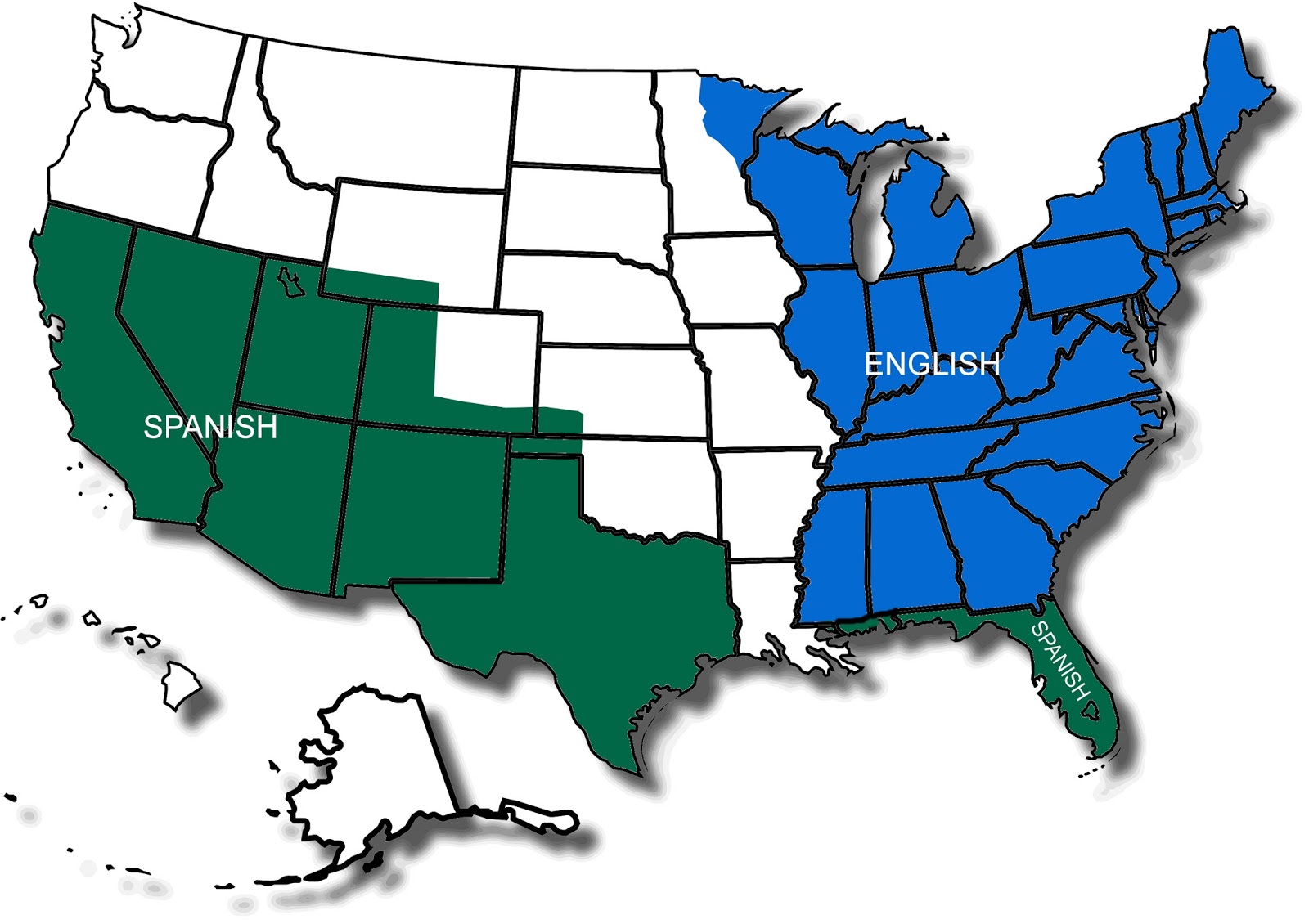
In fact using the criteria of before the 19th century, here is the
truth about the portion of America settled (or stolen from Native
Americans) by Huntington's British Protestants versus the portion of America settled by Spanish Catholics:
The
fact is if you believe Professor Huntington, only
the states indicated above in blue have any serious claim to a 17th and
18th Centuries historical British Protestant cultural heritage.
While
some are careful to make the "English-only" language as a legal argument
there are those who, apparently ignorant of American history, offer a
cultural argument without any historical foundation whatsoever.
For instance, while ICE Agents and bigots are
attacking the Hispanic neighborhoods in California, no one is attacking
the many "Little Italy" communities in the United States as indicated in Wikipedia:
Several Little Italies exist in New York City, including:
Little Italy, Manhattan
Italian Harlem
Pleasant Avenue, East Harlem, Manhattan
Little Italy, The Bronx
Morris Park, Bronx
Country Club, Bronx
Pelham Bay, Bronx
Bensonhurst, Brooklyn
South Brooklyn
Carroll Gardens, Brooklyn
Cobble Hill, Brooklyn
Bay Ridge, Brooklyn
Dyker Heights, Brooklyn
Williamsburg, Brooklyn;
Howard Beach, Queens
Ozone Park, Queens
Astoria, Queens
Middle Village, Queens
Rosebank, Staten Island
Many Staten Island neighborhoods (44% of Borough Residents claim Italian ancestry)
Little Italy, Chicago, in Illinois
Elmwood Park, Illinois
Melrose Park, Illinois
Norridge, Illinois
Berwyn, Illinois
Grand Ave, Chicago
Little Italy, Altoona, in Pennsylvania
Little Italy, Baltimore, in Maryland
North End, Boston, in Massachusetts
Little Italy, Bridgeport, in Connecticut
Franklin Avenue in Hartford, Connecticut
Little Italy, Buffalo, in New York
Little Italy, Rochester - Gates Ny - Lyell Ave & Spencerport Rd
Little Italy, Cleveland, in Ohio
Little Italy, Connellsville, in Pennsylvania
Little Italy in Erie, Pennsylvania, an area centered on West 18th Street between Sassafras and Liberty Streets.
Little Italy, Kansas City, Missouri – Now defunct and mainly inhabited by South East Asian migrants.
Little Italy, Los Angeles – a defunct neighborhood now part of New Chinatown
Wooster Square, in New Haven, Connecticut
East Haven, Connecticut (40% of residents claim Italian ancestry)
Little Italy, Omaha, in Nebraska
Little Italy, Paterson, in New Jersey
South Trenton, New Jersey
South Philadelphia in Philadelphia, Pennsylvania
Federal Hill in Providence, Rhode Island
North Providence, Rhode Island (small town with high number of Italians; about the size of most Little Italies in big cities).
Those who believe as Huntington should be wondering why ICE agents are not deporting American citizens
of Italian descent back to Italy. Of course, on the map above there are no Italian 17th-18th Century
settlements Huntington could worry about.
Which brings us back to Representative King. Despite the fact that his tweet makes him sound like an Alt-Right idiot, when you look back at a 2002 column written by someone who opposed King's first run for Congress, you get a fair picture of King's views (you should really read the whole article to get a good idea of Congressman King):
The large number of Southeast Asian and Latino people who came to Denison and Storm Lake, first as refugees and then later to work in meat packing plants, came after King was out of school, in business and living on a farm between Kiron and Odebolt.
Is he aware that he is often labeled as being “anti-immigrant” now?
“Oh, yeah,” he said. “I know that.”
But he said that’s inaccurate and unfair.
I reminded him of his “Official English” bill, the “God and Country Bill” and his harsh comment in a letter to western Iowa editors after the attacks of Sept. 11, 2001: “Preferential treatment and the obsession with the elevation of every third world culture to the status of our American Civilization are silenced for now and hopefully forever.”
So, how does he feel about immigrants?
“Anybody who comes to this country legally, I’m all for,” he said, “and I think we should all support legal immigration. But I do think we need to secure our borders. I think we need to take a serious look at our immigration policy.”
How does he view those from other cultures and countries, if they are here legally?
“I have a very strong, profound belief that we are all God’s children,” King said. “And I believe that God doesn’t draw distinctions between us to favor one race over another, or to favor men or favor women. We are all equal in God’s eyes.
“That has led me to advocate equal rights for everybody, and by virtue of that, no special rights for anybody.”
He said he enjoys “all the different cultures we have here now. Just look at it in terms of food alone, if you want to. I was raised pretty much on plain meat and potatoes. The variety of all the different kinds of food that other cultures have brought here is great.
“The cultural differences we have add to the richness of our life, and we should study them and celebrate them. But I come into this thing from the viewpoint that there are a lot of things that divide us as Americans, and a lot of multi-cultural efforts seem to divide us rather than unite us.
“When we first started to see multi-culturalism, I was in favor of it. But I now see it often being used as a political tool to divide us, and that concerns me. I like diversity of cultures and peoples, but we also need to recognize there is a greater American culture that unites us. It’s fine to celebrate the individual cultures we come from, but it can’t hinder the greater American culture.”
King said much of his understanding of immigration today, and the way Americans are reacting to it, has come from the writings of Thomas Sowell.
Sowell is a senior fellow at The Hoover Institution at Stanford University in California. He is African American, was born in the South and grew up in Harlem. He is a graduate in economics from Harvard, earned his master’s in that field at Columbia University and his doctorate in economics at the University of Chicago.
He is a widely known and quoted conservative whose books include a 1996 work, “Migration and Cultures: A World View.”
If King and other Neoliberals are concerned that the American Cultural Salad Bowl concept is "being used as a political tool to divide us" and a danger to "a greater American culture that unites us" and specifically are targeting Hispanic and Asian immigration through government policy, then Congressman King and friends are engaging in a culture war against California's history, folklore, identity, and people.
California Empirical Egalitarian Progressivism,
which has the goal of assuring the long term survival and success of
California and Californians, includes a social compact recognizing the
common needs of a disparate peoples. As I explained in #Calexit. Perhaps 170 years of invidious doubtful scorn is enough
we Californians live in a state of migrants. California has been called
the land of sunshine and opportunity in the context of migrants. In
fact people have been migrating here for 10,000 years, and still are
today from East of the Sierras, West of the Pacific, and South of the Border. That's fine with
us.
You see California was part of Spain, then part of Mexico.
It never was part of the British Empire, never, never. It became part of the United
States through a war of occupation by the United States and a treaty imposed on Mexico. California's heritage is Hispanic. Let me make sure this is clear, the heritage of the State of California is Hispanic, not like Massachusetts or New York with their "Little Italy" neighborhoods. Want to visit California from your home state of Iowa....
... you should see the Spanish Missions established by Catholic priests of the Franciscan order between 1769 and 1833. You can travel the El Camino Real.
After touring the Mission San Carlos Borromeo de Carmelo, in Carmel, California, you should visit the Monterey Bay Aquarium in the City of Monterey, which was the capital of Alta California under both Spain and Mexico. That's the Alta California shown on this map:
Since Monterey was the only port of entry for taxable goods in California you should visit the Custom House State Park.
You won't see any sites associated with the Founding Fathers because they were in English colonies thousands of miles away when the fastest travel was by horseback.
I won't repeat all the history of California covered
in prior posts. But American California history begins with a war of occupation as indicated on this map....
...which ended on
February 2, 1848, with the signing in Mexico of the Treaty of Guadalupe Hidalgo.
The treaty added an additional 525,000 square miles to United States
territory, including the land that makes up all or parts of present-day
Arizona, California, Colorado, Nevada, New Mexico, Texas, Utah and Wyoming.
The
Treaty has no direct impact on
Alabama, Alaska, Arkansas, Connecticut, Delaware, Georgia, Hawaii,
Idaho, Illinois, Indiana, Iowa, Kansas, Kentucky, Louisiana, Maine,
Maryland, Massachusetts, Michigan, Minnesota, Mississippi, Missouri,
Montana, Nebraska, New Hampshire, New Jersey, New Mexico, New York,
North Carolina, North Dakota, Ohio, Oklahoma, Oregon, Pennsylvania,
Rhode Island, South Carolina, South Dakota, Tennessee, Vermont,
Virginia, Washington, West Virginia, and Wisconsin.
But
it clearly does apply to California. Among many other things to be
settled after the Mexican-American War, the Treaty provides:
ARTICLE VIII
Mexicans
now established in territories previously belonging to Mexico, and
which remain for the future within the limits of the United States, as
defined by the present treaty, shall be free to continue where they now
reside, or to remove at any time to the Mexican Republic, retaining the
property which they possess in the said territories, or disposing
thereof, and removing the proceeds wherever they please, without their
being subjected, on this account, to any contribution, tax, or charge
whatever.
Those who shall prefer to remain in the said
territories may either retain the title and rights of Mexican citizens,
or acquire those of citizens of the United States. But they shall be
under the obligation to make their election within one year from the
date of the exchange of ratifications of this treaty; and those who
shall remain in the said territories after the expiration of that year,
without having declared their intention to retain the character of
Mexicans, shall be considered to have elected to become citizens of the
United States.
In the said territories, property of every kind,
now belonging to Mexicans not established there, shall be inviolably
respected. The present owners, the heirs of these, and all Mexicans who
may hereafter acquire said property by contract, shall enjoy with
respect to it guarantees equally ample as if the same belonged to
citizens of the United States.
ARTICLE IX
The
Mexicans who, in the territories aforesaid, shall not preserve the
character of citizens of the Mexican Republic, conformably with what is
stipulated in the preceding article, shall be incorporated into the
Union of the United States. and be admitted at the proper time (to be
judged of by the Congress of the United States) to the enjoyment of all
the rights of citizens of the United States, according to the principles
of the Constitution; and in the mean time, shall be maintained and
protected in the free enjoyment of their liberty and property, and
secured in the free exercise of their religion without restriction.
There
are a lot of words in those two Articles, but from my point of view the
United States did agree to respect the culture and heritage of the
Mexican-Americans (and presumably their heirs) then remaining in that
525,000 square miles within which California is wholly located.
Further,
when California's first constitution was drafted in 1849, despite the
fact that the state's Spanish-speaking population was already a
minority,
delegates to the constitutional convention without opposition approved
recognition of Spanish language rights: "All laws, decrees,
regulations, and provisions emanating from any of the three supreme
powers of this State, which from their nature require publication, shall
be published in English and Spanish."
You see, even the Nazi's after they occupied France recognized the language of the natives living there. In fact in 2010 in English invasion 'threatens French language more than Nazis did'
we are told: "The invasion of English words poses more of a "grave
threat" to French national identity than the imposition of German under
the Nazi occupation, according to a group of self-styled guardians of
the French language."
Anyway, one might think this
treaty-based legal history should ameliorate the tension between the
Melting
Pot traditionalists and the multicultural advocates when it comes to the
issue of Hispanic people in the Arizona, California, Colorado, Nevada,
New Mexico, Utah and Wyoming, but it does not.
What I want to say to both the Neoliberals nationalists like King and the rabid
multiculturalists who are still debating is "get over it." But what I will
say is keep your nose out of California's business. We don't do Cultural Melting Pots or Cultural Salad Bowls. We do stews where you can taste everything...
We don't find this insidious and if Carlos O'Brien wants to put
potatoes and carrots in, fine.
Yes, Carlos O'Brien. For more on relevant history read about the Saint Patrick's Battalion, highly revered in Mexico. You see in the mid-1840's Irish and other Catholic immigrants had the impression that the those now revered descendants of English immigrants shouldn't be forcing members of the Army to worship in Protestant services and those Irish had the impression that there was little difference between
British colonial bigotry as they had experienced it in the Ireland they were escaping and
the American Manifest Destiny movement bigotry as it affected Mexicans and Native Americans.
Embracing their English Protestant heritage must have seemed to the Irish immigrants like an odd choice for people living in the home of the first revolution against British colonialism. But like all things American, it was confusing. Some of the folks in the 13 Colonies did not like some British taxes and military policies.
But the United States is still fighting wars in places like Iraq, in the process standing in for the British colonial bigots whose descendants just voted for Brexit mostly to keep out war refugees from places like the Iraq they created from whole cloth bigotry.
It is exactly the attitude the Irish encounted in the America of the 1840's that has resulted in Neoliberalism controlling the United States government. It is good that Twitter exists because without the bumbling tweets, we might not know just how much the Republicans have embraced the tradition of Manifest Destiny bigotry at the core of Neoliberalism.
And we might not understand just how dangerous this is to California's history, folklore, identity and people. But we need to, and then fortify our defenses.
The most obvious truth about Donald Trump's January 25, 2017, Executive Order
titled Border Security and Immigration Enforcement Improvements now being implemented by the Department of Homeland Security is that it only orders the securing of our southern border which is
defined as "the contiguous land border between the United States and
Mexico."
The United States has 5,525 miles of border
with Canada and 1,989 miles with Mexico. Our maritime border includes
95,000 miles of shoreline. That is 102,514 miles of porous border, 1.9%
of which Trump and the Deplorables are apparently concerned about. Securing the other 98.1%
apparently will not allow us to keep out foreign terrorists[... oops, there we go with the lies intended to create confusion ...]will not facilitate going back to the government sponsored bigotry of the 1930's.
Since it would be easy to dismiss the election discourse as meaningless election rhetoric, I feel the need to explain in some detail why this old Native Californian thinks it is time to recognize just how different California is from Ohio and North Carolina and why proposing that Congress authorize the separation of California from the Union is urgent.
Let's begin with a statement of historical facts. Migrants created the California we know today while white illegal aliens from the United States made California a part of the Union. What 96%+ of Americans don't know is the United States government run by the ancestors/predecessors of the current Deplorables...
from 1880-1943 prevented the families of one group of Californians - the U.S. citizen children of Chinese immigrants - from bringing their family members into California, targeting only this ethnic group of Asians,
from 1930-1946 in the Mexican "Repatriation" rounded up and deported one group of Californians - American citizens of Hispanic heritage
from 1942-1945 rounded up another group of Californians - American citizens of Japanese heritage - and put them into concentration camps, and
in 1954 Operation Wetback was begun which resulted in 1,078,168 arrests and deportations by the U.S. Border Patrol resulting in several hundred United States citizens being illegally deported without being given a chance to prove their citizenship.
Sorry America, but we Californians cannot permit a repeat of this kind of bigotry, discrimination, and violence against our people again. After the election, as well as during the campaign, we can observe that focused violence and bullying is growing in the U.S. as a result of Donald Trump and he isn't even President yet.
...Homeland Security Secretary John F. Kelly’s memos have alarmed immigrant rights groups because they supersede most of those issued by previous administrations, including policies from the Obama administration aimed at focusing deportations exclusively on hardened criminals and those with terrorist ties.
Kelly’s directives seek to expand partnerships with local law enforcement agencies to apprehend undocumented immigrants, hire 10,000 new Immigration and Customs Enforcement officers and 5,000 new Border Patrol agents, and broaden expedited deportations, currently limited to those in the country two weeks or less, to those who have been in the country for up to two years.
The provisions mandate that the government detain immigrants until they are granted a hearing before an immigration judge, ending the Obama administration’s policy of releasing some to live with relatives until their hearings. Backlogs at immigration courts have delayed hearings for more than a year.
And yet today the headlines are focused on bathroom use in schools, bathrooms controlled by local school districts and the states, all of which have elected governing bodies. It is almost as if Americans don't understand our governments, don't remember our history and/or don't think the government-caused bigotry that caused untold psychological and physical trauma in the 1930's could happen again. Consider Immigrants: The Last Time America Sent Her Own Packing:
A 9-year-old girl stood in the darkness of a railroad station, surrounded by tearful travelers who had gathered up their meager belongings, awaiting the train that would take her from her native home to a place she had never been. The bewildered child couldn’t know she was a character in the recurring drama of America’s love-hate relationship with peoples from foreign lands who, whether fleeing hardship or oppression or simply drawn to the promise of opportunity and prosperity, desperately strive to be Americans. As yet another act in the long saga of American immigration unfolds today, some U.S. citizens can recall when, during a time of anti-immigrant frenzy fueled by economic crisis and racism, they found themselves being swept out of the country of their birth.
Emilia Castañeda will never forget that 1935 morning. Along with her father and brother, she was leaving her native Los Angeles. Staying, she was warned by some adults at the station, meant she would become a ward of the state. ‘I had never been to Mexico,’ Castañeda said some six decades later. ‘We left with just one trunk full of belongings. No furniture. A few metal cooking utensils. A small ceramic pitcher, because it reminded me of my mother…and very little clothing. We took blankets, only the very essentials.’
As momentous as that morning seemed to the 9-year-old Castañeda, such departures were part of a routine and roundly accepted movement to send Mexicans and Mexican-Americans back to their ancestral home....
We do not want a repeat of this trampling on the U.S. and State Constitutions known as the Mexican Repatriation in which bigotry became public policy. In the book Decade of Betrayal: Mexican Repatriation in the 1930s authors Francisco E. Balderrama and Raymond Rodríguez you can learn more about the subject. But in response to questions in an NPR interview Balderrama explains:
There was not a federal deportation act, even though in some of the literature, it makes reference to that. That did not occur. What one has to be sensitive to to understand this history, is that it occurred in different forms. During the Hoover administration in the late 1920s and early 1930s, particularly the winter of 1930-1931, William Mitchell, the attorney general who had presidential ambitions, instituted a program of deportations. And it was announced that we need to provide jobs for Americans, and so we need to get rid of these other people. This created an anxiety, a tension in the Mexican community. And at the same time, U.S. Steel, Ford Motor Company, Southern Pacific Railroad said to their Mexican workers, you would be better off in Mexico with your own people....
Now, there was the development of a deportation desk from LA County relief agencies going out and recruiting Mexicans to go to Mexico. And they called it the deportation desk. Now, LA legal counsel says you can't do that. That's the responsibility, that's the duty of the federal government. So they backed up and said, well, we're not going to call it deportation. We're going to call it repatriation. And repatriation carries connotations that it's voluntary....
Downtown Los Angeles around the area of the LA Plaza next to Olvera Street right across from, today, Union Station, near Our Lady Queen of the Angels Church. That particular area was cornered off February 26, 1931 - very different approach of the Immigration and Naturalization Service, who had not planned to do that until the unemployment coordinating committee in LA County announced that raids were going to happen in Los Angeles and then after the fact, informed Washington D.C. about that. And then they followed suit and had raids in Pacoima and San Fernando Valley. But the one here in Los Angeles received a great deal of publicity because it was cornering off a popular area of the city and even rounded up a Mexican vice consul and had him in custody as well. Now, the raid itself didn't net that many people that were deported. But more significantly is those are the banner headlines - that here in Los Angeles, the historic founding of Los Angeles, this great Mexican city, this is what happened. And with that, then we have days and weeks that many Mexicans are not visible publicly because they're afraid of these raids that are occurring.
In the Apology Act for the 1930s Mexican Repatriation Program, the California Legislature on behalf of Californians officially apologized for the what was done to 9-year-old Emilia Castañeda and the thousands of other American citizens. As explained in 2006 by the Apology Act's author State Senator Joe Dunn:
Repatriation is, in fact, a misnomer. That was the label put on this program by the Hoover administration starting back in 1930 and 1931. In essence, their theory was, `We're going to repatriate those born here in the United States but of Mexican descent back to their, quote, "mother,"' end quote, `country.' That was their words, not mine. And it was a misnomer because the vast majority of those that were illegally deported under this program were born and raised right here in the United States. And the numbers actually, Melissa, if I may for just a moment, are staggering. Almost two million individuals were illegally deported to Mexico, and it's estimated that almost 60 percent or more of those two million were actually United States citizens born right here in the United States.
The phrase that the Hoover administration used was `American jobs for real Americans.' Well, if you were born and raised right here in the United States but just happened to be of Mexican descent, in the Hoover administration's eyes, you were not a, quote, "real American," end quote.
In a 2006 USA Today article (which today seems a naive time), the lack of awareness of the Mexican Repatriation was explained along with a proposal for an apology to come from Congress, while a new 2006 legislative proposal leading to today's situation was defended and a "justification" was offered for what was done because non-Hispanic white people were unemployed:
...His mother was cooking tortillas when 6-year-old Ignacio Piña saw plainclothes authorities burst into his home.
"They came in with guns and told us to get out," recalls Piña, 81, a retired railroad worker in Bakersfield, Calif., of the 1931 raid. "They didn't let us take anything," not even a trunk that held birth certificates proving that he and his five siblings were U.S.-born citizens.
The family was thrown into a jail for 10 days before being sent by train to Mexico. Piña says he spent 16 years of "pure hell" there before acquiring papers of his Utah birth and returning to the USA.
If their tales seem incredible, a newspaper analysis of the history textbooks used most in U.S. middle and high schools may explain why: Little has been written about the exodus, often called "the repatriation."
That may soon change. As the U.S. Senate prepares to vote on bills that would either help illegal workers become legal residents or boost enforcement of U.S. immigration laws, an effort to address deportations that happened 70 years ago has gained traction.
On Thursday, Rep. Hilda Solis, D-Calif., plans to introduce a bill in the U.S. House that calls for a commission to study the "deportation and coerced emigration" of U.S. citizens and legal residents. The panel would also recommend remedies that could include reparations. "An apology should be made," she says.
Co-sponsor Rep. Luis Gutierrez, D-Ill., says history may repeat itself. He says a new House bill that makes being an illegal immigrant a felony could prompt a "massive deportation of U.S. citizens," many of them U.S.-born children leaving with their parents.
"We have safeguards to ensure people aren't deported who shouldn't be," says Jeff Lungren, GOP spokesman for the House Judiciary Committee, adding the new House bill retains those safeguards.1
"It was a racial removal program," says Mae Ngai, an immigration history expert at the University of Chicago, adding people of Mexican ancestry were targeted.
However, Americans in the 1930s were "really hurting," says Otis Graham, history professor emeritus at the University of California, Santa Barbara. One in four workers were unemployed and many families hungry. Deporting illegal residents was not an "outrageous idea," Graham says. "Don't lose the context."
"We need their jobs for needy citizens," C.P. Visel of the Los Angeles Citizens Committee for Coordination of Unemployment Relief wrote in a 1931 telegram. In a March 1931 letter to Doak, Visel applauded U.S. officials for the "exodus of aliens deportable and otherwise who have been scared out of the community."
In fact, the United States Congress refused to pass a similar apology resolution even though it had taken action to apologize to the Japanese for the WWII internment program. Then again, Congress may not have wanted to be forced to bring up the 1950's Operation Wetback. So it should not be surprising but should be disturbing to all Americans that a similar program is about to recur today.
Sec. 10. Federal-State Agreements. It is the policy of the executive branch to empower State and local law enforcement agencies across the country to perform the functions of an immigration officer in the interior of the United States to the maximum extent permitted by law.
(a) In furtherance of this policy, the Secretary [of Homeland Security] shall immediately take appropriate action to engage with the Governors of the States, as well as local officials, for the purpose of preparing to enter into agreements under section 287(g) of the INA (8 U.S.C. 1357(g)).
(b) To the extent permitted by law, and with the consent of State or local officials, as appropriate, the Secretary shall take appropriate action, through agreements under section 287(g) of the INA, or otherwise, to authorize State and local law enforcement officials, as the Secretary determines are qualified and appropriate, to perform the functions of immigration officers in relation to the investigation, apprehension, or detention of aliens in the United States under the direction and the supervision of the Secretary. Such authorization shall be in addition to, rather than in place of, Federal performance of these duties.
(c) To the extent permitted by law, the Secretary may structure each agreement under section 287(g) of the INA in the manner that provides the most effective model for enforcing Federal immigration laws and obtaining operational control over the border for that jurisdiction.
The California Legislature is considering SB54 which would make the State of California what is called a "sanctuary state." What that means is that state and local officials including law enforcement officers will be severely restricted in how much information they can provide to and how much they can work with Immigration and Customs Enforcement (ICE) and other federal officials involved in implementing immigration laws. But as explained in California could become a sanctuary state. What that means:
The current version of the bill would kick ICE and U.S. Customs and Border Protection out of local jails and restrict their access to some state databases. It also would ban state agencies from asking and collecting anyone’s immigration status.
Police departments and sheriffs’ offices still would work with ICE and Customs and Border Protection on multi-agency task forces, which sometimes result in deportations. Federal immigration authorities still would have access to fingerprint data from everyone booked into a local jail.
Neither federal nor state laws have defined sanctuary cities, so the term means different things to different people.
“The biggest misconception is that people think that when you declare yourself a sanctuary it means that there is absolutely no contact with ICE, and that is not true,” said Marissa Montes, co-director of the Loyola Immigrant Justice Clinic at Loyola Marymount University in Los Angeles. “If ICE wanted to have a raid in downtown LA and did everything procedurally correct, like get a warrant, the city would not be able to stop them.”
The bill has yet to complete its way through the various Senate committees and then must get through the Assembly. If it does all that, and Governor Brown signs it, it could become law almost a year from now. In the meantime, the feds are moving forward.
The California Constitution and various codes do allow the California Attorney General to engage in the strong and vigorous enforcement of state civil rights laws and protect from violations of their rights enumerated under the California Constitution all persons in the State. The California Department of Justice under the Attorney General has a Civil Rights Enforcement Section deals with the civil rights of all persons including immigrants through the Office of Immigrant Assistance.
From a legal standpoint California has had a very long history arguing against the federal government exceeding it's authority on issues involving immigrants. As part of the Compromise of 1850, California was admitted to the United States. Five years later the State Supreme Court set forth it opinion on the primacy of states regarding citizenship in Ex parte Knowles, 5 Ca. 300, 302 (1855) in which the decision reads as follows:
I come now to the consideration of the main question, whether the State courts of California...have the power to naturalize....
In the eighth section of the first article of the Constitution, enumerating the powers of Congress, is the following separate clause: "To establish an uniform rule of naturalization and uniform laws on the subject of bankruptcy throughout the United States." By metaphysical refinement, in examining the form of our government, it might be correctly said that there is no such thing as a citizen of of the United States. But constant usage - arising from convenience, and perhaps necessity, and dating from the formation of Confederacy [this refers to the pre-1789 United States, not the South in the Civil War] - has given substantial existence to the idea which term conveys. A citizen of any one of the States of the Union, is held to be, and called a citizen of the United States, although technically and abstractly there is no such thing....
At the time of the adoption of the Constitution, the States had power to make citizens of aliens. Does the clause of the Constitution above quoted deprive them of it ? The true rule of construction as to the exclusiveness of the power of Congress is, First - That it must be granted exclusively ; Second forbidden to the States; Third - from the nature of the power, exercise by both must be incompatible and incongruous. Does power under review come within either of these positions ? If examine the language closely, and according to the rules of rigid construction always applicable to delegated powers, we will find the power to naturalize, in fact is not given to Congress, but simply the power to establish an uniform rule. The States are not forbidden to naturalize, nor is there anything in the exercise of power by them, incongruous or incompatible with the power of Congress to establish an uniform rule. That the States, if they choose to exercise the power as an original one, must abide by the rule which Congress makes, there cannot be the slightest difference opinion. The power given to Congress was, according to my appre- hension, intended to provide a rule for the action of the States, and not a rule for the action of the federal government....
...The District Courts of this State are fully invested with power and jurisdiction to naturalize foreigners who exhibit the qualifications fixed by the laws of the United States.
Now one might hesitate given the year in which the decision was made, before the Civil War and the Fourteenth Amendment. And the fact is that it was made in liberal California. So let's turn briefly to a more recent frequently quoted ruling in a case involving whether a person could become a sheriff by being a citizen of the state while not a U.S. citizen Crosse v. Board of Supervisors of Elections of Baltimore City 221 A.2d. 431, 243 Md. 555 (Md., 1966) made by the Court of Appeals of Maryland on July 1, 1966:
Both before and after the Fourteenth Amendment to the federal Constitution, it has not been necessary for a person to be a citizen of the United States in order to be a citizen of his state. United States v. Cruikshank, 92 U.S. 542, 549 (1875); Slaughter-House Cases, 83 U.S. (16 Wall.) 36, 73-74 (1873); and see Short v. State, 80 Md. 392, 401-02, 31 Atl. 322 (1895). See also Spear, State Citizenship, 16 Albany L.J. 24 (1877).
However, just before the government put Japanese-American Californians into concentration camps the California Legislature modified the statutory definition of a state citizen to defer to Congress. That is unfortunate, and that law needs to be amended as suggested here.
It is important that Californians and the California Government act rapidly and firmly to legally disrupt any reinstitution of federal actions resembling Mexican "Repatriation" and Operation Wetback. If the institutionalization of bigotry isn't enough to generate a sense of urgency, there is this headline which you can click on to read the story:
In the meantime, there is this article:
__________________________
Footnotes: 1
Jeff Lungren, GOP spokesman for the House Judiciary Committee, in 2006 was
defending HR4437, which was passed by the U.S. House of Representatives but not
the U.S. Senate, and which contained the following Trumpian provisions among others...
Requires up to 700 miles (1120 km) of double-layered fence along the Mexico–US
border at points with the highest number of illegal border crossings. (House
Amendment 648, authored by Duncan Hunter (R-CA52)
Requires the federal government to take custody of illegal aliens detained by
local authorities. This would end the practice of "catch and release", where
federal officials sometimes instruct local law enforcement to release detained
illegal aliens because resources to prosecute them are not available. It also
reimburses local agencies in the 29 counties along the border for costs related
to detaining illegal aliens. (Section 607)
Mandates employers to verify workers' legal status through electronic means,
phased in over several years. Also requires reports to be sent to Congress one
and two years after implementation to ensure that it is being used. (Title VII)
Requires the Department of Homeland Security (DHS) to report to Congress on the
number of Other Than Mexicans (OTMs) apprehended and deported and the number of
those from states that sponsor terrorism. (Section 409)
Formalizes Congressional condemnation of rapes by smugglers along the border and
urges Mexico to take immediate action to prevent them. (House Amendment 647,
authored by Ginny Brown-Waite)
Requires all illegal aliens, before being deported, to pay a fine of $3,000 if
they agree to leave voluntarily but do not adhere to the terms of their
agreement. The grace period for voluntary departure is shortened to 60 days.
Requires DHS to conduct a study on the potential for border fencing on the
Canada–US border.
Sets the minimum sentence for fraudulent documents at 10 years, fines, or both,
with tougher sentencing in cases of aiding drug trafficking and terrorism. Establishes a Fraudulent Documents Center within DHS.
Increases penalties for aggravated felonies and various frauds, including
marriage fraud and document fraud.
Establishes an 18-month deadline for DHS to control the border, with a progress
report due one year after enactment of the legislation.
Requires criminal record, terrorist watch list clearance, and fraudulent
document checks for any illegal immigrant before being granted legal immigration
status.
...which is why that article seems so naive -
a product of Americans refusing to learn anything about their history and government.