Showing posts with label Economy. Show all posts

Thursday, June 28, 2018

The Development of Artificial Intelligence (AI)
  AI should be regulated but perhaps not by
  an elected, divisive U.S. legislative body


Which photo represents The Dawn of the Age of Artificial Intelligence?
    "Halt and Catch Fire (HCF): An early computer command that sent the machine into a race condition, forcing all instructions to compete for superiority at once. Control of the computer could not be regained." - title card for the TV series Halt and Catch Fire
    In computer engineering, Halt and Catch Fire, known by the assembly mnemonic HCF, is an idiom referring to a computer machine code instruction that causes the computer's central processing unit (CPU) to cease meaningful operation, typically requiring a restart of the computer. - Wikipedia
Greg Brockman is likely a name you do not recognize even though he is on the 2018 Forbes List 30 Under 30 - Enterprise Technology. He's 29. The Forbes entry reports his education as follows: "Drop Out, arvard University; Bachelor of Arts/Science, Massachusetts Institute of Technology (also drop out)." It tells you he resides in San Francisco.

Brockman testified before Congress Tuesday on artificial intelligence (AI). Thinking about Brockman reminded me of....


Halt and Catch Fire


In its first season, the TV series Halt and Catch Fire won the Critic's Choice Television Award for Most Exciting New Series. By the third season it had a 96% approval rating on Rotten Tomatoes. In its fourth and final season which received critical acclaim it held a 100% approval rating on Rotten Tomatoes.

Per Wikipedia: "Taking place over a period of ten years, the series depicts a fictionalized insider's view of the personal computer revolution of the 1980s and later the growth of the World Wide Web in the early 1990s."

Halt and Catch Fire told the story of a few people who found themselves in the middle of the creation of technology that thus far has driven the 21st Century. It aired on AMC from June 1, 2014, to October 14, 2017.

On February 6, 2018, it won the Women's Image Network Awards award for Best Drama Series. For the show offered the best representation of women in tech and management in ways you would have a hard time finding elsewhere.

For someone who was involved with computers beginning in the 1970's and 1980's the show was a historical piece, a story of the late 20th Century, and well done. It also reminded me of how young and naive we were - unaware of the real implications of what we were doing.

One programmer observed: “I know that something’s coming, something big, like a train, and all I want is to jump on board. But it’s getting faster and faster and I’m terrified I’m going to miss it … I don’t want to get left behind.”

With foresight, another young staffer in his suicide note warned: “Beware of false prophets who will sell you a fake future, of bad teachers and corrupt leaders and dirty corporations … But most of all beware of each other, because everything is about to change. The world is going to crack wide open. The barriers between us will disappear, and we’re not ready. We’ll hurt each other in new ways. We’ll sell and be sold. We’ll expose our most tender selves only to be mocked and destroyed. We’ll be so vulnerable and we’ll pay the price.”

Airing in the second decade of the 21st Century, the series offers hindsight which sometimes provides us with insight regarding current activities. And yet, relatively few Americans watched it. And why would they?

After all as late as 2006 United States Senator Ted Stevens was reflecting the average American's understanding of the technology that could make or break their employer in that decade:
    Ten movies streaming across that, that Internet, and what happens to your own personal Internet? I just the other day got… an Internet was sent by my staff at 10 o'clock in the morning on Friday. I got it yesterday [Tuesday]. Why? Because it got tangled up with all these things going on the Internet commercially.
    ...They want to deliver vast amounts of information over the Internet. And again, the Internet is not something that you just dump something on. It's not a big truck. It's a series of tubes. And if you don't understand, those tubes can be filled and if they are filled, when you put your message in, it gets in line and it's going to be delayed by anyone that puts into that tube enormous amounts of material, enormous amounts of material.
Even recognizing that Stevens was just one member of Congress, most of us who were involved in the computer industry in the 1970's and 1980's, who also had governmental/political involvement, understood that the 19th Century U.S. Constitution was entering a "Halt and Catch Fire" condition. Because it is government, it would take about a decade before the need to "reboot" our federal government with all new "machine code" uploaded would become obvious.

And indeed in 2016 the need to "reboot" our federal government with all new "machine code" did become obvious, with the Russian interference in the Presidential Election based solely upon the use of primary goal of the American corporate internet - advertising to make corporations rich. And indeed in 2016 the need to "reboot" our federal government with all new "machine code" did become obvious with the effective use of internet social media by a reality game show host who had no previous political or government experience to get himself elected President.

The fact "it won't work anymore" came from knowning that Ted Stevens chaired the United States Senate Committee on Commerce, Science and Transportation. And because of his very limited knowledge about 21st Century technology he used the "series of tubes" metaphor to criticize a proposed amendment to a committee bill which would have prohibited Internet service providers such as AT&T, Comcast, Time Warner Cable and Verizon Communications from charging fees to give some companies' data a higher priority in relation to other traffic.

And today while Congress members are somewhat better versed on the 50-year-old technology, their median expertise level is only slightly better than knowing how to watch cat videos on YouTube. Even their staffers are most certainly not at the level necessary to begin the process of regulating Artificial Intelligence. The "cat video" level of knowledge (along with a predisposition to listen to corporate lobbyists in order to fund reelection campaigns) is why in the United States achieving privacy and security on the internet through Congressional action will never happen.


The Dawn of the Age of Artificial Intelligence


On Wednesday November 30, 2016, Greg Brockman gave his first testimony on Capitol Hill to the Senate Commerce Subcommittee on Space, Science, and Competitiveness. The subject matter of the hearing was "The Dawn of the Age of Artificial Intelligence" and the Chair of the Subcommittee was a different Senator named Ted. Here are some of the hearing opening remarks from Senator Ted Cruz:
    Today, we’re on the verge of a new technological revolution, thanks to the rapid advances in processing power, the rise of big data, cloud computing, mobility due to wireless capability, and advanced algorithms. Many believe that there may not be a single technology that will shape our world more in the next 50 years than artificial intelligence. In fact, some have observed that, as powerful and transformative as the Internet has been, it may be best remembered as the predicate for artificial intelligence and machine learning.
    Artificial intelligence is at an inflection point. While the concept of artificial intelligence has been around for at least 60 years, more recent breakthroughs...have brought artificial intelligence from mere concept to reality.
    Whether we recognize it or not, artificial intelligence is already seeping into our daily lives. In the healthcare sector, artificial intelligence is increasingly being used to predict diseases at an earlier stage, thereby allowing the use of preventative treatment, which can help lead to better patient outcomes, faster healing, and lower costs. In transportation, artificial intelligence is not only being used in smarter traffic management applications to reduce traffic, but is also set to disrupt the automotive industry through the emergence of self-driving vehicles. Consumers can harness the power of artificial intelligence through online search engines and virtual personal assistants via smart devices, such as Microsoft’s Cortana, Apple’s Siri, Amazon’s Alexa, and Google Home. Artificial intelligence also has the potential to contribute to economic growth in both the near and long term. A 2016 Accenture report predicted that artificial intelligence could double annual economic growth rates by 2035 and boost labor productivity by up to 40 percent.
    Furthermore, market research firm Forrester recently predicted that there will be a greater-than-300-percent increase in investment in artificial intelligence in 2017 compared to 2016. While the emergence of artificial intelligence has the opportunity to improve our lives, it will also have vast implications for our country and the American people that Congress will need to consider, moving forward....
    Today, the United States is the preeminent leader in developing artificial intelligence. But, that could soon change. ...Ceding leadership in developing artificial intelligence to China, Russia, and other foreign governments will not only place the United States at a technological disadvantage, but it could have grave implications for national security.
    We are living in the dawn of artificial intelligence. And it is incumbent that Congress and this subcommittee begin to learn about the vast implications of this emerging technology to ensure that the United States remains a global leader throughout the 21st century. This is the first congressional hearing on artificial intelligence....
As did a number of leaders in the AI industry, Brockman gave an extensive presentation. Here are some key points:
    I’m Greg Brockman, Co-Founder and Chief Technology Officer of OpenAI. OpenAI is a nonprofit AI research company with a billion dollars in funding. Our mission is to build safe, advanced AI technology, and to ensure that its benefits are distributed to everyone....
    The U.S. has led essentially all technological breakthroughs of the past 100 years. And they’ve consistently created new companies, new jobs, and increased American competitiveness in the world. AI has the potential to be our biggest advance yet.
    Today, we have a lead, but we don’t have a monopoly, when it comes to AI. This year, Chinese teams won the top categories in a Stanford annual image recognition context. South Korea declared a billion-dollar AI fund. Canada actually produced a lot of the technologies that have kicked off the current boom. And they recently announced their own renewed investment into AI.
    So, right now I would like to share three key points for how the U.S. can lead in AI:
    The first of these is that we need to compete on applications. But, when it comes to basic research, that should be open and collaborative....
    The second thing...is that we need public measurement and contests. There’s really a long history of contests causing major advances in the field. For example, the DARPA Grand Challenge really led directly to the self-driving technology that’s being commercialized today. ...Measures and contests help distinguish hype from substance, and they offer better forecasting. ...Good policy responses and a healthy public debate are really going to depend on people having clear data about how the technology is progressing. What can we do? What still remains science fiction? How fast are things moving? So, we really support OSTP’s recommendation that the government keep a close watch on AI advancement, and that it work with industry to measure it.
    The third thing that we need is that we need industry, government, and academia to start coordinating on safety, security, and ethics. The Internet was really built with security as an afterthought. And we’re still paying the cost for that today.
    Academic and industrial participants are already starting to coordinate on responsible development of AI. For example, we recently published a paper, together with Stanford, Berkeley, and Google, laying out a roadmap for AI safety research. Now, what would help is feedback from the government about what issues are most concerning to it so that we can start addressing those from as early a date as possible.
    ...The best way to create a good future is to invent it. And we have that opportunity with AI by investing in open, basic research, by creating competitions and measurement, and by coordinating on safety, security, and ethics.
Tuesday's joint meeting of the House Subcommittee on Research and Technology and Subcommittee on Energy offers insight into how it is when technology advances at the hands of young creators, even ones who are concerned about the deficits in the process. You can watch it on YouTube (note: the action doesn't start until 22 minutes into the video):


The problem is the expert witnesses are asking the technology challenged, AI-uninformed to create regulations, an ethics system, when the experts themselves are unable to know and describe what problems are likely to arise from a technology level that does not exist and has never been tested.

The baseline example is the so-called "autonomous" vehicle. In that case, the first step is to acquire a dictionary and discover "autonomous" means "existing or capable of existing independently, not subject to control from outside."

In other words, an autonomous vehicle will decide where it's going and what route it's taking, and also drive itself there. Would you climb into such a vehicle, perhaps right after you named it "Hal" (and if you don't recognize that reference, you do need to stream the movie 2001: A Space Odyssey).

On the other hand, a "self-driving" vehicle is capable of driving to the destination on the roads you tell it to, hopefully safely without your intervention through the controls such as the steering wheel or brakes.

Despite the fact that self-driving-capable vehicles exist, American governments are having trouble regulating them and there are no ethical nuances involved.

In 2016 Brockman observed: "The Internet was really built with security as an afterthought. And we’re still paying the cost for that today." That was after the 2016 election but before the full scope of the Russian interference problem was known. Unfortunately, we have no answers for the security problem that does not in some way interfere with either individual freedom or individual privacy or both.

I cannot even begin to imagine the operating assumption that will go into real AI, assumptions that will turn out to be false - you know, the ooops of technology. I cannot even begin to consider the complex ethical and moral issues that will arise even if the AI is not in the form of a Dolores (pictured to the right at the top of this post), Bernard, Maeve, or Teddy.

Government? In considering and effectively dealing with such a complex issue as AI and with the opinions of hundreds of millions of people slowly learning about AI, you're looking a two decades of debate. Then, of course, it will be too late to have avoided layers of crises.

If you think I'm wrong, you may want to read the paper prepared for the Academy to the Third Millennium February 1997 Conference Internet & Politics entitled "Regulation and Deregulation of the Internet."  Presented by Columbia University by professor of Finance and Economics and Paul Garrett Chair in Public Policy and Business Responsibility Eli Noam who is the director of the Columbia Institute for Tele-Information (CITI).

 In order to set context, let me return to the TV series Halt and Catch Fire. Episode 1 of Season 3. The year is 1986. The place is Silicon Valley. And Mutiny, the little internet startup that could, is celebrating a 100,000-person user base and independence from the outsourced servers it once relied upon to keep itself running. Let me repeat - the year is 1986.

Noam's presentation was given in February 1997, over a decade after real life young tech nerds like those depicted in Halt and Catch Fire were establishing the internet. His presentation was over a decade after the internet became obvious to many and nearly 20 years before the Russian interference in the U.S. Presidential election in which the only candidate who knew how to effectively use social media (because he was the only non-politician) won. In that 1997 context Noam muses:
    A myth is going around that has almost been elevated to the status of platitude: “you cannot regulate the Internet.” There is a related myth, that “a bit is a bit,” that no bit can therefore be treated differently from any other, and that attempts at control are therefore doomed to fail. Both claims, though originating with technologists who implicitly seem to believe in technological determinism, are wrong even as a matter of technology....
    Also, communication is not just a matter of signals but of people and institutions. For all the appeal of the notion of “virtuality,” one should not forget that physical reality is alive and well. Senders, recipients, and intermediaries are living, breathing people, or they are legally organized institutions with physical domiciles and physical hardware. The arm of the law can reach them. It may be possible to evade such law, but the same is true when it comes to tax regulations. Just because a law cannot fully stop an activity does not prove that such law is ineffective or undesirable.
    This, most emphatically, does not mean that we should regulate cyberspace (whatever it is). But that is a normative question of values, not one of technological determinism. We should choose freedom because we want to, not because we have to. And that choice will not be materially different from those which societies generally apply. As the Internet moves from a nerd-preserve to an office park, shopping mall, and community center, it is sheer fantasy to expect that its uses and users will be beyond the law. This seems obvious. Yet, for many, the new medium is like a Rorschach test, an electronic blob into which they project their own fantasies, desires and fears for society. As the Russians say: Same bed, different dreams. Traditionalists find the dark forces of degeneracy, as in everything. Libertarians find an atrophy of government. Leftists find a new community, devoid of the material avarice of private business. This kind of dreaming is common for new and fundamental technology, and it is usually wrong.
    A society’s choice of rules will depend, among other things, on its willingness to accept risk. The Internet is new and unchartedterritory.  The term “electronic frontier” is quite apt. As it happens, America has been in the frontier business for a long time. It’s good at it. It’s its defining characteristic,together with liberty and free enterprise. No wonder then that America is atthe leading edge of the information age.
    It is a common fallacy to over-estimate the short term but to under-estimate the long term.  Thus, we over-estimate the short-termability of electronic communications to be free of government controls, because it is believed that “you can’t regulate the Internet.”  But the long-term is another matter. The long-term leads to entirely new conceptsof political community. Just as traditional banks and traditional universities will decline, so will traditional forms of jurisdiction. A few years ago, it became fashionable to speak of communications creating the"global village."-- communal and peaceful. But there is nothing village-like in the unfolding reality. Instead, groups with shared economic interests are extending national group pluralism through the opportunity to create global interconnection with each other into the international sphere. The new group networks do not create a global village, they create instead the world as a series of electronic neighborhoods.
    Communications define communities, and communities define politics. Thus, the breakdown of the coherent national communications system reflects and accelerates a fundamental centrifugalism that will reshape, in time, countries and societies. We are barely at the beginning of this evolution, and the forces of resistance are only beginning to fathom the impacts.
It has been 55 years since Americans began to use something resembling today's internet. The earliest ideas for a computer network intended to allow general communications among computer users were formulated in April 1963 by computer scientist J. C. R. Licklider in memoranda discussing the concept of the "Intergalactic Computer Network". Those ideas encompassed many of the features of the contemporary Internet. In October 1963, Licklider was appointed head of the Behavioral Sciences and Command and Control programs at the Defense Department's Advanced Research Projects Agency (ARPA). Funded by ARPA of the United States Department of Defense,  ARPANET became the technical foundation of the Internet.

To put it simply, it has been over a half a century since the U.S. Government began creating the internet. In the face of various national security agencies needs for access to everyone's data which the private sector apparently already has, Congress is struggling with how to establish any semblance of security and privacy in the face of what was created by funding approved by...Congress.

In April the following headline appeared in Newsweek AI Candidate Promising ‘Fair and Balanced’ Reign Attracts Thousands of Votes in Tokyo Mayoral Election. That article seemed just about as informed about AI as Congress. In a different source we are offered a more prescient perspective:
    Whether it's samurai robots, a hotel staffed by robots, or AI girlfriends, it seems that it safe to say that one should keep their eye on Japan when it comes to developments in the field of artificial intelligence. So while it seemed a foregone conclusion that AI would eventually break into the world of politics, the way we're seeing it do so in one city in Japan is a bit surprising. The mayoral election of Tama City in Tokyo is featuring its first "AI candidate".
    At least, that's what one can take from the promise of mayoral candidate Michito Matsuda. Matsuda has chosen to throw his hat into the election but is deferring to an AI-powered robot avatar, as he intends to maximize the use of artificial intelligence and rely on it heavily in the running of his municipal administration.
    As he writes on his Twitter account (which is run in character in an AI persona), "For the first time in the world, AI will run in an election. Artificial intelligence will change Tama City. With the birth of an AI-Mayor, we will conduct impartial and balanced politics. We will implement policies for the future with speed, accumulate information and know-how, and lead the next generation."
Even though he lost the election, Matsuda's effort could lead to a possible discussion regarding whether politicians or AI could do a better job at governing. And so long as Americans keep voting for candidates they can socially relate to, the answer some day could be AI. Or not as discussed in AI 101: Why AI is the Next Revolution–or Doomsday.


I'm not sure which will be more disruptive to humanity - AI or Climate Change. But I can tell Greg Brockman and Dr. Fei-Fei Li that the Congressional testimony they gave earlier this week is almost a complete waste of time.


California Joins the EU
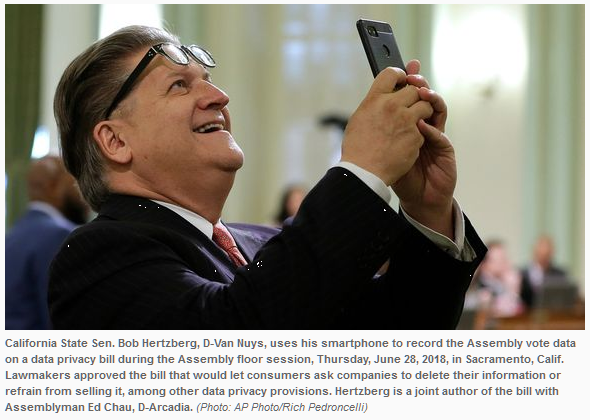


With all of that said, California - the home of Silicon Valley - is attempting to step in where Congress has failed essentially by adopting online privacy rules consistent with the General Data Protection Regulation (GDPR) of the European Union that became effective May 25.

The GDPR begins with a simple statement: "The protection of natural persons in relation to the processing of personal data is a fundamental right. Article 8(1) of the Charter of Fundamental Rights of the European Union (the ‘Charter’) and Article 16(1) of the Treaty on the Functioning of the European Union (TFEU) provide that everyone has the right to the protection of personal data concerning him or her." The term "natural persons" is used to distinguish humans from corporations in emphasizing human rights over economic constructs.

And so this week the California Legislature passed the toughest online privacy law in these United States. However, it doesn't take effect until January 2020 though, in order to allow the Silicon Valley corporations to prepare.

Under the new law, California consumers will have the right to:
  • know all the data collected by a business and be able to transfer it twice annually for free;
  • to opt out of having their personal information sold (but companies will then be able to charge those consumers higher fees);
  • to delete their data;
  • to tell a business it can't sell their data;
  • to know why the data is being collected;
  • to be informed of what categories of data will be collected before it's collected and to be informed of any changes to that;
  • to be told the categories of third parties with whom their data is shared and the categories of third parties from whom their data was acquired;
  • to have businesses get permission before selling any information of children under the age of 16.

As the Los Angeles Times noted With the federal government missing in action, California should set its own rules for internet privacy.

Regarding Artificial Intelligence, Brockman, Li, and their compatriots should move their advocacy effort for an AI regulatory/ethics structure to the California Legislature. That is because, as we've pointed out on a number of issues, it is the Progressive Pacific Message that must be advocated:


The problem is that if individuals use the California online privacy law, it is very likely that the U.S. Supreme Court, with its membership reflecting the privacy preferences of most of the folks not in the Pacific States, would ultimately overturn it as a proscribed interference in interstate commerce. That is because the U.S. Constitution as literally written by the Founding Fathers primarily provides for (a) the conduct international relations including military defense and (b) provides for the regulation of interstate commerce exclusively by Congress. It took amendments contained in what we know as the Bill of Rights to have any provisions for human rights and online privacy was not included.

The U.S. Government because of its "machine code" known as the Constitution is simply not capable of surviving the 21st Century.

Sunday, October 29, 2017

"Clear waters and green mountains are mountains of gold and silver."
  Seeking a Beautiful China and California
  together in harmony for our grandchildren


    Pollution has become a scourge in China, the debilitating consequences of rapid industrial development. Chinese people are exceedingly displeased to see their air, water and soil so polluted, and the government has responded by elevating "Green Development", the third development concept, to highest national importance. One of the pioneers has been East China's Zhejiang province, where in 2005 Xi Jinping, then Zhejiang Party secretary, famously said: "Clear waters and green mountains are mountains of gold and silver." Putting the theory into practice, Zhejiang has pioneered an "eco-compensation" system, which enables regions to both preserve the environment and develop eco-friendly industries. - from "The five major development concepts" by Robert Lawrence Kuhn
This post is the last of four on the 21st Century political and cultural objectives that have been set by China.


Xi Jinping, of course, has been President of China since March 14, 2013. And if you haven't read the above posts, you can click on the images above where you might learn about the most important government policy developments of the 21st Century to date which will impact on your grandchildren's generation. You will also learn about Xi, the fellow human overseeing the implementation of those policies.

Of course, these government policy developments have nothing to do with Donald Trump. And of course, they are too complex for social media. And of course, because their goals are targeted for 2049 China they have no real impact on the day-to-day lives of Americans today. So of course, Americans generally have no awareness of them.

In 2005 Xi Jinping, then Zhejiang Province Communist Party Secretary, was not even on any pundits radar though in 2002 Xi was elected a full member of the 16th Central Committee. His environmental statement quoted above "Clear waters and green mountains are mountains of gold and silver" was far from pandering to the popular thinking.

In the first decade of this century, climate change skepticism in China was worse than in the U.S. as discussed in The Convenient Disappearance of Climate Change Denial in China: From Western plot to party line, how China embraced climate science to become a green-energy powerhouse. Fortunately, as the article notes: "By the time China adopted its 12th Five-Year Plan in 2011, a green strategy had begun to crystalize."

Keep that 2011 year in mind as you read this posted two weeks ago in the South China News:
    Ten years ago [October 2007], as early autumn set in and the Communist Party of China prepared to convene its 17th National Congress in Beijing, the names of two Lis – Liaoning party chief Li Keqiang and Jiangsu party chief Li Yuanchao – were making the rounds as odds-on favourites to emerge from the scrum of candidates to be anointed supreme leader-in-waiting of the party’s Fifth Generation.
    Newly appointed party chief of Shanghai, Xi Jinping, was not expected to contend for the post. He had just been elevated to his position in spring 2007, was expected to continue serving as Shanghai party chief, and there was no prior precedent of a regionally based leader serving concurrently on the party’s Politburo Standing Committee – the party’s highest decision-making organ.
    By mid-autumn, the script had been re-written.
    In the ‘open audition’ selection process at the party congress for the 25-member Politburo, which for the first time allowed all Central Committee members to vote from a wider pool of candidates drawn from provincial and ministerial-level cadres, Xi won the most support.
    The day after the National Congress, at the First Plenum of the party’s 17th Central Committee, Xi was selected as the sixth-ranking member of the nine-member Politburo Standing Committee and executive secretary of the party’s Secretariat. Later that December, he was appointed president of the Central Party School – mirroring the path that Hu Jintao had taken during his elevation to the supreme leader-in-waiting position in the late-1990s.
    That Xi was neither a protégé of Jiang [Jiang Zemin, President from 1993 to 2003] nor belonged to Hu-linked groupings [Hu Jintao, President from 2003 to 2013] – and therefore his elevation was beholden to neither factional politics nor to the reigning supreme leader’s dictates, was also instrumental in his meteoric rise to the top.
Five months later, at the 11th National People's Congress in March 2008, Xi was elected as Vice-President of the People's Republic of China. By the time of that 2011 Five Year Plan, Xi's vision of "clear waters and green mountains" had become the basis for policy.

On 15 November 2012, Xi Jinping was elected to the post of General Secretary of the Communist Party and Chairman of the CPC Central Military Commission by the 18th Central Committee of the Communist Party of China and on 14 March 2013 was elected President of the People's Republic of China by the 12th National People's Congress.

China is the largest country in the world in terms of population, second only to Russia in terms of land area, and the second only to the United States in terms of GDP (though China is firstcwhen measured by purchasing power parity). As noted in the May 23 post linked above, California and Californians need strong ties to China for economic growth and measures to reduce climate change impacts.

In the pictures at the top of this post, Governor Jerry Brown is shown during his June 2017 trip to China with Chinese  Science and Technology Minister Wan Gang (left) and with Chinese President Xi Jinping (right).

Shortly before meeting with President Xi, Brown, one of the co-chairs of a bipartisan group of U.S. Governors called the Climate Alliance,  signed an agreement providing that China and the Golden State will work together on cutting their greenhouse gas (GHG) emissions over time.

From renewable energy technologies to zero-emission vehicles, from low carbon infrastructures to electricity efficiency savings, a working group of top-level officials from both sides will continually plot ways to cooperate on climate measures and to zero in on initiatives that will help both countries cut their carbon footprints.

The agreement builds on subnational pacts Brown signed with officials in Sichuan and Jiangsu provinces earlier this week.

“California is the leading economic state in America and we are also the pioneering state on clean technology, cap and trade, electric vehicles and batteries, but we can’t do it alone,” Brown said before a Chinese delegation.

"I have proposed that California will cut its greenhouse gases 40 per cent below 1990 levels and that we'll have 50 per cent of our electricity from renewables," Brown told President Xi Jinping in a 45-minute meeting.

"To keep that goal, we need a very close partnership with China - with your businesses, with your provinces, with your universities," Brown said. 

"Nobody can stay on the sidelines. We can't afford any dropouts in the tremendous human challenge to make the transition to a sustainable future," Brown said during a green energy conference in Beijing. "Disaster still looms and we've got to make the turn."

Chinese President Xi expressed support for California to play a bigger role in promoting exchange and cooperation between China and the United States. He said he hoped California could continue to promote bilateral exchanges between localities and contribute more to China-U.S. cooperation in areas including technology, innovation and green development.  He welcomed California to join the Belt and Road Initiative.

Voicing appreciation of Xi's speech at the World Economic Forum annual meeting at Davos in January, Brown said California was willing to join the construction of the Belt and Road and was looking forward to a stronger cooperative relationship with China in trade, investment, clean technology and environmental protection.

Which brings us to the point of these posts. Climate change and economic issues in California are intricately tied to China. And going even further, understanding Chinese history, problems, and politics can help to understand the continuing political evolution of the United States and particularly of California. For example, consider the issue of multiculturalism.

China has about 7000 years of history, 1.4 billion people, and 56± ethnic groups. About 92% are considered Han Chinese while 8% are:

Ethnic Group
Major Areas of Distribution
Achang
Yunnan
Bai
Yunnan, Guizhou
Bao'an
Gansu
Bouyei
Guizhou
Bulang
Yunnan
Dai
Yunnan
Daur
Inner Mongolia, Heilongjiang, Xinjiang
De'ang
Yunnan
Dong
Guizhou, Hunan, Guangxi
Dongxiang
Gansu, Xinjiang
Drung
Yunnan
Ewenki
Inner Mongolia, Heilongjiang
Hani
Yunnan
Hezhen
Heilongjiang
Hui
Ningxia, Gansu, Henan, Hebei, Qinghai, Shandong, Yunnan, Xinjiang, Anhui, Liaoning, Heilongjiang, Jilin, Shaanxi, Beijing, Tianjin
Gaoshan
Taiwan (population not counted), Fujian
Gelo
Guizhou, Guangxi
Jing
Guangxi
Jingpo
Yunnan
Jino
Yunnan
Kazak
Xinjiang, Gansu, Qinghai
Kirgiz
Xinjiang, Heilongjiang
Korean
Jilin, Liaoning, Heilongjiang
Lahu
Yunnan
Li
Hainan
Lisu
Yunnan, Sichuan
Loba
Tibet
Manchu
Liaoning, Jilin, Heilongjiang, Hebei, Beijing, Inner Mongolia
Maonan
Guangxi
Miao
Guizhou, Hunan, Yunnan, Guangxi, Sichuan, Hainan, Hubei
Mongba
Tibet
Mongolian
Inner Mongolia, Xinjiang, Liaoning, Jilin, Heilongjiang, Gansu, Hebei, Henan, Qinghai
Mulam
Guangxi
Naxi
Yannan, Sichuan
Nu
Yunnan
Oroqen
Inner Mongolia, Heilongjiang
Ozbek
Xinjiang
Pumi
Yunnan
Qiang
Sichuan
Russian
Xinjiang
Salar
Qinghai, Gansu
She
Fujian, Zhejiang, Jiangxi, Guangdong
Shui
Guizhou, Guangxi
Tajik
Xinjiang
Tartar
Xinjiang
Tibetan
Tibet, Qinghai, Sichuan, Gansu, Yunan
Tu
Qinghai, Gansu
Tujia
Hunnan, Hubei
Uygur
Xinjiang
Va
Yunnan
Xibo
Xinjiang, Liaoning, Jilin
Yao
Guangxi, Hunan, Ynnan, Guangdong, Guizhou
Yi
Sichuan, Yunnan, Guizhou, Guangxi
Yugu
Gansu
Zhuang
Guangxi, Yunnan, Guangdong, Guizhou

If one wants to talk about a "melting pot" and assimilation or multicultural diversity, China is the place to go, not the United States. DNA sampling indicates that the Han Chinese have about the same kind of historical experience as white European Americans - practically everybody is mixed because that is the result of constant human migration.

Language, however, does represent a clearer picture of multicultural diversity. Let's begin with this from the Microsoft Technet Citizenship Asia Pacific site Celebrating Linguistic Diversity on International Mother Language Day:

On 21 February, we celebrate International Mother Language Day, aimed at promoting linguistic and cultural diversity and multi- lingualism. A world map denoting the native languages spoken in different countries. Image courtesy of Daniel Dalet on d-maps.com.

2,200—that is the estimated number of languages spoken in Asia Pacific, more than any other region in the world. Check out some interesting facts about Asian languages that you might have missed out learning in school:
  • Mandarin Chinese has the most native speakers of any language, with an estimated 12.5 percent of the world's population speaking it as their first language. If you are planning to pick up Mandarin, don’t be daunted by the fact that it has 50,000 characters—practice always makes perfect!
  • There are 830 listed languages in the island state of Papua New Guinea (PNG), accounting for the greatest concentration of linguistic diversity on Earth today. Sitting in what is known as a language hot-spot—an area where many languages face the threat of extinction—linguists from National Geographic’s Enduring Voices programme are surveying many in PNG to better understand the world’s languages and the forces that drive language extinction.
  • Asia is home to some of the world’s most endangered languages, including the Ainu in Japan, Dumi in Nepal and Manchu from China. The youngest speakers of these languages are often grandparents themselves, who are only able to speak them partially and infrequently.
While this rich variety of languages continues to shape and preserve the unique cultural identities of many Asian communities, language barriers can be a significant concern.
Within China there is a diversity of languages and cultures many as 292 living language identified though most are very small populations. The map below gives a sense of the areas where larger populations speak a language other than Mandarin which is spoken by 70% of the population:


This gives China problems as reflected in this 2016 story China aims to ease ethnic tensions with integration policy which is an indication that 7000 years of history still offers no solution to the "melting pot" versus "multicultural diversity" debate.

Pictures do appear in the press like the one on the right of police patroling the streets of the Muslim Uighur quarter in Urumqi after a series of violent incidents hit the Xinjiang region in the summer of 2013. China’s state-run media blamed around 100 people it branded as “terrorists” for sparking “riots” in the ethnically-divided region of western China.

On December 31, 2013, President Xi Jinping appeared on CCTV and extended his “New Year’s wishes to Chinese of all ethnic groups.”

The history is complicated as it is in the United States. As one commenter noted in Are Ethnic Tensions on the Rise in China? the answer is time frame dependent. From month to month the answer is sometimes yes and sometimes no. Since the formation of the People's Republic of China in 1949 regarding the Tibetans and Uighurs, China saw major armed rebellions during the mid 1950s, the imposition of martial law in 1989, and the 1990s were particularly volatile with many clashes, bombings, and assassinations. So right now, ethnic tensions are not quite so tense.

But just like us, they will see pictures appear like the one above and in this modern age occasional disturbing videos. Because just like us, they find it complicated to bring humans together. It is what makes politics and governing difficult.

Xi clearly stated that he wants a "country that is prosperous, strong, democratic, culturally advanced, harmonious, and beautiful." His Silk Road Economic Belt and the 21st-century Maritime Silk Road plan covering 65 nations, about 60 per cent of the world’s population and a third of global GDP, involves the integration of a large region into a cohesive economic area through building infrastructure, increasing cultural exchanges, and broadening trade (see more details in the May 23 post here). He invited California to participate when meeting with Governor Brown.

We in California need to understand China and its politics. And we need to understand it without a bias that derives from a mid-20th Century view of communism. As explained in the last post, the folks in charge over there are the ones who were shipped off to rural farms to work after their parents were arrested, imprisoned, humiliated, tortured, and in some cases killed. It's safe to assume that they want far better for the next generations.

We need to be seeking together in harmony a beautiful China and California with clear waters and green mountains for our grandchildren. Xi and Brown are making the effort. So should all of us.

Friday, October 27, 2017

Xi's team to lead a 21st Century China
  They want for their grandchildren a
  prosperous, strong, democratic, culturally
  advanced, harmonious, and beautiful life

The Standing Committee of the Political Bureau of the 19th CPC Central Committee from left, Han Zheng, 63, the Communist Party Secretary of Shanghai; Wang Huning, 62, Director of the Central Policy Research Office; Li Zhanshu, 67, Director of the General Office of the Communist Party of China; President Xi Jinping, 64, General Secretary of the Communist Party of China ; Premier Li Keqiang, 62, Premier of the People's Republic of China; Wang Yang, 62, Vice Premier of the People's Republic of China; and Zhao Leji, 60, Secretary of the Central Commission for Discipline Inspection.

For the first time at the end of a National Congress of the Communist Party of China (CPC), all seven Standing Committee members of the Political Bureau were born after the founding of the People's Republic of China in 1949.

All were born and raised in the People's Republic of China. That means that none of them were WWII veterans and none were part of the Revolution. Instead, all were impacted as children from 1958 to 1962 by Chairman Mao's Great Leap Forward and as teens by Chairman Mao's Cultural Revolution from 1966 until 1976.

The Great Leap Forward was intended through the use of persuasion and force to rapidly transform the country from an agrarian economy into a socialist society through rapid industrialization and collectivization but instead caused economic regression, the Great Chinese Famine, and tens of millions of deaths. Welcome to childhood.

The goal of the Cultural Revolution was to preserve 'true' Communist ideology in the country by purging remnants of capitalist and traditional elements from Chinese society, and to re-impose Maoist thought as the dominant ideology within the Party. Millions of people were persecuted in the violent struggles that ensued across the country, and suffered a wide range of abuses including public humiliation, arbitrary imprisonment, torture, hard labor, sustained harassment, seizure of property and sometimes execution. A large segment of the population was forcibly displaced, most notably the transfer of urban youth to rural regions during the Down to the Countryside Movement. Historical relics and artifacts were destroyed. Cultural and religious sites were ransacked.

To understand the meaning of this history to these seven men, one only need to look at the experience of President Xi Jinping.

After the founding of the Communist state in 1949, Xi's father held a series of posts, including propaganda chief, vice-premier, and vice-chairman of the National People's Congress. Xi was born June 15, 1953. Based on normal expectations, Xi's future looked bright.

But when Xi was age 10, his father was purged from the Party and sent to work in a factory in Luoyang, Henan. In May 1966, Xi's "high school years" were cut short by the Cultural Revolution, when all secondary classes were halted for students to criticise and fight their teachers. Xi was age 15 when his father was jailed in 1968.

In 1969, lacking the protection of his father, Xi was sent to work in Yanchuan County, Shaanxi, in Mao Zedong's Down to the Countryside Movement. After a few months, unable to stand rural life, he ran away to Beijing. He was arrested during a crackdown on deserters from the countryside and sent to a work camp to dig ditches.

In 1981, the Party declared that the Cultural Revolution was "responsible for the most severe setback and the heaviest losses suffered by the Party, the country, and the people since the founding of the People's Republic" Welcome to adolescence.

Read the Wikipedia entry on Xi for more details (and the Wikipedia entry on Peng Liyuan his folksinger wife who until 2007 was more well-known). Also, in 2007 when it became evident that Xi was being groomed to assume the duties of his current job, an article appeared in The Guardian which helps provide some perspective from a British point of view: Most corrupt officials are from poor families but Chinese royals have a spirit that is not dominated by money.

The following graphic indicates the Party organization.
The seven-member Political Bureau Standing Committee is the center of political power in China. While certainly this year the generational factor is important, it is also important to know that five of the seven are new to the Standing Committee.


It is also true that none are in their fifties, a fact troubling to some American pundits. In more recent times being in that 50's age group would have indicated a Standing Committee member was being prepared to replace President Xi five years from now in 2022.

Of course, in 2022 only one of the Standing Committee members will be as old as Donald Trump was when he became U.S. President this year. In fact, in 2022 President Xi will be 69, two years younger than Trump is right now!

For more about these seven men, Hong Kong's South China Morning Post offers this: China's Leadership Reshuffle: Profiles.

More troubling to many is that none of these guys are women. In fact, at the next level down, in the 25 member Political Bureau (aka Politburo), the number of from two women members to one after the 19th National Congress.

Of the delegates to the Party Congress, only 24.1% were women. When comparing ruling parties, that is about the same ratio as the delegates to the 2016 Republican Party National Convention. (The 2016 National Convention of the losing Democratic Party had about 60% women.)

China's two most senior female politicians a month ago were vice premier Liu Yandong, 71, a scion of a political dynasty -- her father was a close ally of former Chinese President Jiang Zemin -- and Sun Chunlan, a rising Party chief.

In this week's leadership reshuffle, Liu retired from the Politburo, leaving Sun as the only female member. Sun Chunlan, 67, is head of the party’s United Front Work Department, the agency that serves as the Party's interface with individuals and organizations that are not Party members that have social, commercial, or academic influence, or who represent important interest groups, both inside and outside China.

Another woman politician better known to the West, Fu Ying, 64, an ethnic Mongol born in the Inner Mongolia Autonomous Region of China, is not a member of the Politburo, although she has held Ambassador posts to Australia and the Philippines and currently holds the position of vice foreign minister after a long career in the Chinese diplomatic service. In 2010 the Financial Times offered an extensive article Lunch with the FT: Madam Fu Ying which included this giving us an insight into her formative years:
    Fu Ying was born in 1953 in Hohhot, the capital of Inner Mongolia, an “autonomous region” of China. Her parents were bilingual, speaking Mandarin and Mongolian. Her father wrote poetry. She can, she tells me, still remember the day that a tall, ethnically Chinese man arrived at the family home to take her father away. It was 1967 and the height of the Cultural Revolution, the bloody chaos unleashed by Mao to purge the party and consolidate power.
    “The [tall] man looked into my eyes and said, ‘Democracy is great. Do you know what is democracy?’ I shook my head; I didn’t know. And he said, ‘That’s the change of history. You will be swept away by the change of history.’” (Democracy, during the Cultural Revolution, was equivalent to anarchy. No wonder, I muse to myself, it does not carry the same positive connotations in China as in the west.)
    A tear appears in Madam Fu’s eye. She recounts how school was shut down and she was taken away, aged 17, to a remote town in the mountains, Wulashan, five hours distant by train. There she worked in the fields – “very, very physical, really stressful and extreme for a young girl” – before helping to build a new factory where she was employed as an announcer, broadcasting information to her co-workers about the weather and the like through a loudspeaker.
    But then, in 1973, she had her first break. The Cultural Revolution was in its last throes and previously frowned-upon practices such as examinations to test pupil ability were revived. Fu Ying excelled, having squirrelled away first Russian and then French classics from a library in Wulashan. She also excelled in English, having picked up the basics on Chinese radio. She gained a place to study for four years at Beijing Foreign Studies University.
    After the death of Chairman Mao in 1976, China started to open to the rest of the world. Suddenly, interpreters were in heavy demand. Madam Fu joined the elite translation department of the diplomatic service.
It is clear that the generation now leading China had a less than enchanting experience with Mao's brand of authoritarianism under the name communism. On the other hand, for these and most Chinese people, China has a 7,000 year history, most of which has been as a moderately successful single autocratic state under an emperor. [To learn more about China, its history and culture, watch the six episode Story of China at PBS.org.]

While most of us who live in the Progressive Pacific states have some awareness of China, it is important to understand how the current Chinese leadership generation sees the world. Among others, Fu Ying has been tasked with assisting us. In 2016 in Foreign Affairs her article How China Sees Russia she provides clear insight into information we should understand:
    ...China has no interest in a formal alliance with Russia, nor in forming an anti-U.S. or anti-Western bloc of any kind. Rather, Beijing hopes that China and Russia can maintain their relationship in a way that will provide a safe environment for the two big neighbors to achieve their development goals and to support each other through mutually beneficial cooperation, offering a model for how major countries can manage their differences and cooperate in ways that strengthen the international system.
    On several occasions between the end of the nineteenth century and the middle of the twentieth century, China entered into an alliance with the Russian empire and its successor, the Soviet Union. But every time, the arrangement proved short-lived, as each amounted to nothing more than an expediency between countries of unequal strength. In the decades that followed, the two powerful communist-led countries muddled through, occasionally cooperating but often riven by rivalry and mistrust. In 1989, in the waning years of Soviet rule, they finally restored normalcy to their relations. They jointly declared that they would develop bilateral relations based on “mutual respect for sovereignty and territorial integrity, mutual nonaggression, noninterference in each other’s internal affairs, equality and mutual benefit, and peaceful coexistence.” Two years later, the Soviet Union disintegrated, but Chinese-Russian relations carried on with the principle of “no alliance, no conflict, and no targeting any third country.”
    Soon thereafter, the newborn Russian Federation embraced the so-called Atlanticist approach. To win the trust and help of the West, Russia not only followed Western prescriptions for economic reform but also made concessions on major security issues, including reducing its stockpile of strategic nuclear weapons. However, things didn’t turn out the way the Russians had hoped, as the country’s economy tanked and its regional influence waned. In 1992, disappointed with what they saw as unfulfilled pledges of American and European assistance and irritated by talk of NATO’s eastward expansion, the Russians began to pay more attention to Asia. That year, China and Russia announced that each would regard the other as a “friendly country” and issued a joint political statement stipulating that “the freedom of people to choose their own development paths should be respected, while differences in social systems and ideologies should not hamper the normal progress of relations.”
    Ever since, Chinese-Russian relations have gradually improved and deepened. During the past 20 years or so, bilateral trade and investment have expanded on a massive scale. In 2011, China became Russia’s largest trading partner. In 2014 alone, China’s investment in Russia grew by 80 percent—and the trend toward more investment remains strong. To get a sense of the growth in economic ties, consider that in the early 1990s, annual bilateral trade between China and Russia amounted to around $5 billion; by 2014, it came close to $100 billion. That year, Beijing and Moscow signed a landmark agreement to construct a pipeline that, by 2018, will bring as much as 38 billion cubic meters of Russian natural gas to China every year. The two countries are also planning significant deals involving nuclear power generation, aerospace manufacturing, high-speed rail, and infrastructure development. Furthermore, they are cooperating on new multinational financial institutions, such as the Asian Infrastructure Investment Bank, the New Development Bank BRICS, and the BRICS foreign exchange reserve pool.
In the middle of the 2008 financial crisis Xi said: "First, China doesn't export revolution; second, China doesn't export hunger and poverty; third, China doesn't come and cause you headaches. What more is there to be said?"

This past week Xi reaffirmed that Beijing will never seek hegemony or engage in expansion "no matter what stage of development it reaches" and that "China will never pursue development at the expense of others' interests and its development does not pose a threat to any other country."

In her 2010 article Fu Ying noted:
    In remarks during [his visit to the United States in 2009], Xi directly addressed the idea that China’s development presents a challenge to the United States’ global leadership. “The path China follows is one of peaceful development, and China does not pose a threat to other countries,” Xi said. Later, he added, “People should give up the old concepts of ‘you lose, I win,’ or zero-sum game, and establish a new concept of peaceful development and win-win cooperation. If China develops well, it will benefit the whole world and benefit the United States. If the United States develops well, it will also benefit the world and China.”
If one pays attention to what this new generation of Chinese leadership communicates, we can create a consistent set of China-centered goals that evolve from this 2008 statement:


In 2012 Xi's goal for 2020 was made clear:


And now, in 2017, Xi set forth for 2049 the goal of achieving "a great modern socialist country that is prosperous, strong, democratic, culturally advanced, harmonious, and beautiful."

We need to know and understand these people.


This post is the third one of four on the 21st Century political and cultural objectives that have been set by China. Click on the images below to read the other three.


Monday, October 23, 2017

Xi Jinping's strategy for a 21st Century China
  With thoughtful Chinese characteristics
  a President tends his plan for 1.4 billion
  people for 2020 ...and 2035 ...and 2049


The 19th National Congress of the Communist Party of China (CPC) was began last week, a once-every-five-years gathering.

Speaking for three hours and 23 minutes, China's President and Party General Secretary Xi Jinping delivered the opening report to the nearly 2,300 party delegates who represent China's
  • 22 provinces; 
  • five autonomous regions, each with a designated minority group; 
  • four municipalities; 
  • two Special Administrative Regions;
  • plus the central financial system, state-run institutions, the military and the police.
The People's Republic of China is the world's most populous country, with a population of around 1.404 billion, and at 9.3 million square kilometres (3.6 million square miles), is the world's second-largest state by land area. For comparison, the United States of America has 23% of the population at 0.324 billion people, but at 9.1 million square kilometres (3.5 million square miles) is almost as big geographically.

As usual, the American press struggled with its coverage of the 19th National Congress (however limited it was, which means very limited). Of course many American "journalists" couldn't even tell you how the government works that is responsible for the contents of their own toilet after its flushed, much less explain how government really works in China. And many bring to the subject of China's government a nationalistic bias of their own heavily colored by mid-20th Century views on communism and socialism.

Yes, the Communist Party of China provides the leadership of the state. However, to understand government in China one must understand this explanation from Wikipedia:
Due to China's large population and area, the administrative divisions of China have consisted of several levels since ancient times. The constitution of China provides for three de jure levels of government. Currently, however, there are five practical (de facto) levels of local government: the provincial (province, autonomous region, municipality, and special administrative region), prefecture, county, township, and village.

Since the 17th century, provincial boundaries in China have remained largely static. Major changes since then have been the reorganization of provinces in the northeast after the establishment of the People's Republic of China and the formation of autonomous regions, based on Soviet ethnic policies. The provinces serve an important cultural role in China, as people tend to identify with their native province.
As with President Donald Trump, China's President Xi has no direct role overseeing local sewage systems. But unlike an American President, Xi is the General Secretary of the Communist Party in a de facto one-party state and holds ultimate, albeit indirect, authority over almost all government officials through the Communist Party.

Nonetheless, it is important to note that the governmental electoral system is pyramidal. Local People's Congresses are directly elected, and higher levels of People's Congresses up to the National People's Congress (NPC) are indirectly elected by the People's Congress of the level immediately below. The political system is decentralized, and provincial and sub-provincial leaders have a significant amount of autonomy.

The most recent post here in this blog - in May - was about President Xi, the Belt and Road Forum for International Cooperation, and the California-China Business Summit during ChinaWeek.

The Belt and Road Forum was President Xi's opportunity to lay out a broad foreign policy with an emphasis on creating a 21st Century China that could replace the United States as the world's preeminent economic power - much like the United States replaced a floundering Europe in the 20th Century.

This past week's 19th National Congress of the Communist Party of China sets the agenda for the future of China beginning with that all-important three-hour “work report” speech by Xi.

To provide insight into President Xi's zeal to assure a strong future for his country, it is important to remember that on February 11, 2009, while visiting Mexico, then Vice-President Xi spoke in front of a group of overseas Chinese noting that China's task was to keep "its 1.3 billion people from hunger."

And regarding the 2008 financial crisis affecting the Atlantic oriented world filled with complaints about Chinese foreign trade: "There are some bored foreigners, with full stomachs, who have nothing better to do than point fingers at us. First, China doesn't export revolution; second, China doesn't export hunger and poverty; third, China doesn't come and cause you headaches. What more is there to be said?"

This week President Xi Jinping reaffirmed that Beijing will never seek hegemony or engage in expansion "no matter what stage of development it reaches" and that "China will never pursue development at the expense of others' interests and its development does not pose a threat to any other country."

Since the 18th CPC Congress in 2012, in which Xi assumed his current position, China's "two centenary goals" were to
  1. build a moderately prosperous society by 2020, one year before the Party's 100th anniversary in 2021, and 
  2. develop China into a "fully modernized, socialist nation" by the 100th anniversary of the People's Republic of China in 2049.
To accomplish the goals, the "Four Comprehensives" came into being:
  1. comprehensively build a moderately prosperous society (put forward at the November 2012 18th Party Congress),
  2. comprehensively deepen reform (put forward at the November 2013 3rd Central Committee Plenum),
  3. comprehensively and strictly govern the Party (put forward at the early October 2014 summary meeting of the Mass Line Campaign), and
  4. comprehensively advance the rule of law (put forward during the late October 2014 4th Central Committee Plenum).
Additionally,  the "Five Development Concepts" from the 13th Five Year Plan (2016-2020) of innovation, coordination, green, openness and shared development were to be implemented.

This week Xi offered in his report a plan to "build on the foundation created by the moderately prosperous society" by implementing "a further 15 years of hard work to see that socialist modernization is basically realized" from 2020 to 2035, and then from 2035 to the middle of the 21st century "work hard for a further 15 years and develop China into a great modern socialist country that is prosperous, strong, democratic, culturally advanced, harmonious, and beautiful."

But Xi warned that it would be "no walk in the park. It will take more than drum beating and gong clanging to get there." He noted how China had "taken a driving seat in international cooperation to respond to climate change," additionally noting: "Only by observing the laws of nature can mankind avoid costly blunders in its exploitation. Any harm we inflict on nature will eventually return to haunt us. This is a reality we have to face!"

And thus in three hours and 23 minutes President Xi Jinping under the title Thought on Socialism with Chinese Characteristics for a New Era laid out his vision for the Chinese people. “The Chinese nation … has stood up, grown rich, and become strong – and it now embraces the brilliant prospects of rejuvenation … It will be an era that sees China moving closer to centre stage and making greater contributions to mankind.”

Fortunately, the Xinhua News Agency, the official press agency of the People's Republic of China, a ministry-level institution subordinate to the Chinese central government, provided this post-speech summary infographic:


It would be interesting to compare the Chinese President's hopes for his country for the next 30 years, plus the plans for his country to be implemented over the next five years, to those of the U.S. President.

It would be interesting if it weren't for the fact that the U.S. President's thinking is limited to 140 character tweets. It would be interesting if it weren't for the fact that the Trump Administration thinks in those deplorable American time frames described in the last post as "much of our business activity is controlled by a 5 to 10 week time frame and generally Americans struggle with a planning attention span of 5 to 10 days."

Even more troubling is the fact that key members of the Trump Administration are simply uninformed or misinformed about China.

Which brings us again to author and Forbes Contributor Wade Shepard. As noted in the previous post, Shepard is one of those rare American's who, in addition to being able to read and write well above a 6th grade level, is a China expert based upon his travels and study in China. In a post this past Thursday, Shepard wrote:
    On October 3rd, US Defense Secretary James Mattis proclaimed at a congressional hearing, "In a globalized world, there are many belts and many roads, and no one nation should put itself into a position of dictating 'One Belt, One Road.'"
     While the defense secretary was ultimately correct -- there are many different countries who are driving trans-Eurasian integration and China’s international infrastructural, economic, and political engagements do often overlap with other initiatives -- the style, scope, financial backing, strategy, and underlaying purpose behind China's Belt and Road Initiative (BRI) puts it in a category all its own, and should not be underestimated. We have perhaps never seen a program of geo-economic positioning quite like this before, and skeptically framing it in with known practices or established models is a mistake that political analysts, government officials, and even investors have been making -- even as they are encircled by the very initiative they write off or deny.
     If you’re looking for an official, correct map of where China’s Belt and Road actually goes, good luck. If you’re looking for an official explanation of what it really is, a list of approved projects, the amount of actual funding, where this funding is really coming from, what entities have the authority to engage projects under its name (and what entities don't), or even a run down of what countries are officially a part of it, you’ve just jumped down into a very deep hole of misinformation, no information, and all out propaganda.
     This is an initiative for which there are no publicly-stated KPI [Key Performance Indicator], no overarching institutionalization, no formal membership protocols, no founding charters, and a timeline for development that is not measured in mere years, but decades.
In a post the previous week The Real Reason Behind What's Driving China's Ambitions For A New Silk Road Shepard which describes a natural gas pipeline constructed at a cost of cost $7.5 billion under a 2007 contract negotiated by Xi's predecessor President Hu Jintao which this month will begin shipping natural gas to China.
    ...China’s appetite for this energy source is growing at an impressive clip, and is expected to rise 8.1% annually until 2030, which is far above the 2.1% global annual growth rate.
    If we looked at the entire BRI in terms of China increasing, bolstering, and securing their energy supply lines alone — without any of the rhetoric about global prosperity and “win-win” partnerships — it would still make sense. The economic powerhouse that is China requires energy to run, and this is something the country has not been able to handle on its own since at least 1993.
    Diversifying the sources of foreign oil and gas has been of tantamount importance to Beijing for well over a decade. In 2006, the Brookings Institute pointed this out in no uncertain terms:
    "The Chinese government recognizes that the diversification of China’s oil suppliers and import routes can enhance the security of the country’s oil supply. In terms of oil suppliers, China has sought not only to expand the number of countries and regions from which it imports oil but also to limit its dependence on the Persian Gulf, which in 2005 provided China with almost half of its crude oil imports… In terms of import routes, China wants to reduce its dependence on the sea lines of communication through which almost 90% of the country’s crude oil imports travel because of their vulnerability to disruption on the high seas by various modern navies."
    At this time, the focus of this diversification was mainly on the array of new China-bound oil and gas pipelines that were being dug across Russia and Central Asia. What could not be foreseen then was the attempt to create no less than three multimodal transport corridors that China would spearhead under the premise of the BRI to enable energy shipments from the Middle East and to enter the country while bypassing the heavily US Navy-fortified Straight of Malacca. These three prospective corridors extend overland from the ports of Bandar Abbas in Iran, Gwadar in Pakistan, and Kyauk Pyu in Myanmar up to China, enabling energy shipments to go partway by sea and then the rest of the way by pipeline or potentially even rail.
It is obvious that Xi sincerely hopes for a moderately prosperous China by 2020, a fully modernized China by 2035, and a prosperous, strong, democratic, culturally advanced, harmonious, and beautiful China by 2049. It is also obvious that he is proud of what China is achieving in the 21st Century.

Orville Schell, head of the Asia Society’s Center on US-China Relations and a veteran China expert who has been studying Chinese politics since the late 1950s, noted that Xi's "Socialism with Chinese Characteristics is a viable counter-model to the presumption of western liberal democracy and capitalism. In a sense, what Xi is setting up here is not only a clash of civilization and values, but one of political and economic systems."

Xi could comfortably note how China had "taken a driving seat in international cooperation to respond to climate change." He added: "Only by observing the laws of nature can mankind avoid costly blunders in its exploitation. Any harm we inflict on nature will eventually return to haunt us. This is a reality we have to face!"

Xi could also note: “No one political system should be regarded as the only choice and we should not just mechanically copy the political systems of other countries. The political system of socialism with Chinese characteristics is a great creation.”

He could say this because he and those in his administration know that with the election of Donald Trump the United States has...
  • a Republican President who by a large margin lost the popular vote (for the second time since the year 2000);
  • a Senate in which 60 of the 100 Senators with 60% of the vote in the Senate represent less than 25% of the population, while 18 of the 100 Senators with only 18% of the vote in the Senate represent the majority of Americans, and despite the fact that more votes were cast for Democratic candidates than Republican candidates in the last three Senate elections, Republicans control the Senate;
  • a House of Representatives in which Democratic candidates received a nationwide plurality but the Republican candidates won a majority of the House seats; and
  • a nationwide justice system that randomly injures, kills, or imprisons large numbers of non-white American citizens without a trial, creating the highest incarceration rate in the world with about 22 percent of the world's prisoners in a nation that has about 4.4 percent of the world's population.
...leaving Americans with no ability at all to respond to Xi's "political system" challenge by claiming their government is a democracy - assuming democracy in any sense means majority rule based on the popular vote.

China is facing challenges which if covered by balanced reporting in the U.S. would seem familiar to Americans. Today, nearing the end of the 19th Congress, the Minister of Education Chen Baosheng, Minister of Civil Affairs Huang Shuxian, Minister of Human Resources and Social Security Yin Weimin, Minister of Housing and Urban-Rural Development Wang Menghui, and Minister of National Health and Family Planning Commission Li Bin held a joint news briefing.


Minister of Human Resources and Social Security Yin Weimin noted that despite the 3.95% registered unemployment rate in China's urban areas at the end of September "raising the capacity to employ workers overall still faces large pressures."

"We need to create 15 million jobs per year," Yin said, singling out China’s more than 8 million new university graduates that enter the job market each year as one group in need of additional employment.

Yin also said the low unemployment rate in the face of an overall slowdown in the economy was largely due to the new internet economy and entrepreneurship, adding that the ministry would actively support startups to help them “thrive”.

He reported "We've helped 8.8 million people in strained circumstances find jobs," adding that the total number of rural migrant workers increased from 263 million in 2012 to 282 million in 2016.

At the two-hour briefing held partly to address what President Xi called China’s “principle contradiction” between the country’s unbalanced and inadequate development and the people’s ever-growing need for a better life, the ministers outlined some of what they consider to be the biggest achievements of the last five years. Among those achievements is the expansion of basic medical insurance to cover 1.3 billion people and educational opportunities for 90 percent of disabled children.

With 230 million people over the age of 60, making up nearly 1/5 of the population, the challenges grow. Minister Huang Shuxian said they are making progress in providing better facilities for those senior citizens noting “28,000 elderly care homes with nearly seven million beds have been registered across the country. Elderly care service facilities are available in all urban communities and in over half of China’s rural communities.”

Minister Chen Baosheng noted the continuing unbalance of educational resources between urban and rural areas, and even among different districts of individual cities. “The basic focus of our policies is to provide benefits to rural areas, to poor performing schools, to less privileged areas, and to people with economic difficulties,” Chen Baosheng said laying out goals for 2020: an 85 percent gross enrollment rate in three-year kindergarten, and 90 percent in high-schools.

While this was a press briefing, not a new conference, the following CGTN America coverage on YouTube provides a video context though it does have to be pointed out that CGTN is the collection of international language news channels run by the China's government-owned broadcaster China Central Television:


In terms of the goals of China's government, this week provided a good opportunity to learn so long as one recognizes in this context that "short-term" means five years while the year 2049 looms on the Chinese culture's visible horizon.

The year 2049 looms on the California culture's visible horizon also. We might want to give some thought to how China's goals might impact us as we cope with economic and environmental issues.

To learn more about China, its history and culture, watch the six episode Story of China at PBS.org.


This post is the second one of four on the 21st Century political and cultural objectives that have been set by China. Click on the images below to read the other three.